
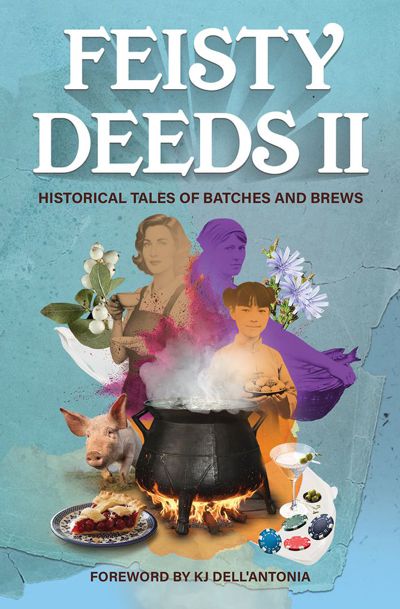
Meals, treats, brews, and potions from another batch of feisty characters.
Whether cooking for solace, scrounging for food, concocting medicine, or brewing poisons, the feisty women in these stories will keep you thirsting for more. Twenty-five tales will transport you far afield in time and place: third century Ireland, medieval Europe, twentieth-century Australia. Read your way from a hippie commune to a WW II internment camp in the Philippines; from a Renaissance palace to a Polish village wracked by war, the hills of Appalachia, and a sleepy Ontario town.
Mixtures to soothe, heal, and thrall are prepared in these pages, where lovers take revenge, mothers protect their children, and feisty women make choices in a challenging world.
Edited by Carolyn Korsmeyer, Christy Matheson, Elaine Aucoin Schroller, Kay Smith-Blum, and Kimberly Sullivan
Foreword by K.J. Dell’Antonia, New York Times best-selling author of the novels The Chicken Sisters, Playing the Witch Card, In Her Boots, and the non-fiction book How to Be a Happier Parent.
All proceeds earned from this collection are destined for the WFWA Scholarship Fund, which benefits authors with financial constraints, allowing them access to conferences, writing craft classes, and technology that will enhance their writing careers.
Excerpt from “Just Desserts”
Franklin County, Virginia 1934
“Did you kill Duane Ferguson?”
Bob rolled the pen between his fingers; agitated, but not ready to call me out as a murderer. He’d been ’round this house since God was a boy, like clockwork every Friday night, pickin’ up his jug for the weekend. Daddy claimed Bob was his most loyal customer. And now that I ran the still? My daddy was right. In twenty years, Bob’d never missed a Friday night pick-up. And if someone turned him in to his boss, Sheriff Thornton? Well, he was another customer.
But, this won’t no backroad-Virginia Friday night pick-up. In this moment, Bob was an officer of the law, and I ran an illegal still that my dead, drunk brother-in-law frequented.
“Did you hear me, Emma?”
I stared into his deep brown eyes, bloodshot and rheumy like my beagle’s. I sorta felt sorry for him. So I decided to throw him a bone.
“I did not kill Duane Ferguson,” I said, proud of how calm I sounded.
Bob pinched the bridge of his nose. Daddy used to do that when he suspected I won’t bein’ completely honest.
“Do you know who did?”
“Bob,” I laughed. “Seriously? You know as well as I do there’s a line of people stretchin’ to the next county who’d love to see Duane’s sorry hide six feet under.”
“Do you know who or not, Emma?” Bob’s voice pitched higher on my name, a clear sign he thought I knew sumthin’.
“No. I don’t know who.”
I didn’t lie. As far as I knew, there won’t no who that killed Duane, but a what. And that I did know.
We sat in silence as Bob scratched out some words on his notepad, then turned back to me.
“When did you last see him?”
“Yesterday.”
“You were at the house?”
“Yes. I went to check on Lucy.”
“Why?”
“She’s my sister, Bob, you know that.”
“But why yesterday? Don’t you usually go see her on Mondays?”
“Usually. But I been busy. Hadn’t seen her in nearly a week.”
I thought about the last six days. No harm in sharin’ some of the truth.
“I did go Monday, but Duane told me she was sick and I couldn’t see her. So, I went back the next day, with soup, but he still won’t let me in the house. I gave it ’til yesterday ’fore I needed to lay eyes on her for myself.”
“And how was she?”
Now it got tricky. It was common knowledge that Duane was a drunk who treated Lucy worse than his huntin’ dogs. The truth about how I found her wouldn’t be no surprise.
“How you think she was? She won’t sick, I’ll tell ya that.”
Bob shook his head. “Worse than last time?”
“Different,” I sighed. “No broken bones far as I can tell, but she’s missin’ teeth. Not gonna be seein’ outta both eyes any time soon either.”
I thought about adding how they could probably take Duane’s fingerprints from the marks on her wrist, the purply-red imprints as recognizable as beads on a bracelet. But we’d seen that before.
“Damn, I’m sorry.”
I just nodded. Duane and his cousins were a mangy bunch, beatin’ women for fun and huntin’ the rest of the time. They’d been arrested so often Sheriff Thornton and I jokingly named a holding cell after them.
“Ya know, no one would blame you if you did kill him. Hell, you’d probably get a medal for ridding the county of him.”
“Ya might be right ’bout that.”
“Where’s Lucy now?”
“Safe. If you have any questions, just ask Sheriff Thornton. He’s aware.”
Bob scribbled more words before returning his gaze to my hands. “Lookin’ pretty torn up there,” he said pointing to my fingers. “You been out fighting thorn bushes?”
“Lotta work keepin’ a farm runnin’.”
“Rumor has it, you got ’bout thirty people out there to help you.”
I slid my hands into my lap, out of view. I knew we’d entered dangerous territory. No one, ’cept Sheriff Thornton, knew about the women and children I housed. I’d devoted my life, and the money from my still, to keepin’ ’em safe from men like Duane. I’d risk my life—had risked my life—to keep ’em from livin’ like Lucy. I couldn’t risk any of ’em being found. We may have Sheriff Thornton’s protection, but he won’t here and Bob was startin’ to make me nervous.
“I heard you got quite the herb garden. Growing all kinds of things…thyme, oregano, dill, foxglove, belladonna, hellebore. That’s an interesting mixture, don’t you think?”
“Well, ya know what they say, variety is the spice of life.”
“Now, I may be wrong, so correct me if I am, but I heard you flavor your mash.”
“I do. But you know that.”
I winked. Just a way of reminding him he’d tasted a variety of flavors over the years.
“Well, that’s not exactly what I’m talking about, now is it?”
I concentrated on keepin’ my face still and sayin’ nuthin’. Both nearly impossible to do. It was common knowledge, by those needin’ my services, that I had special flavors for situations needin’ unique attention. But I doubted Bob knew for a fact ’bout these ingredients. Best keep my answer snappy.
“I try to use seasonal fruits, like apples and peaches. Folks seem to like my fruity brews.”
“They do that, but that’s not what I’m asking. Let me be more direct: I heard you flavor your mash with herbs.”
I pulled a hangnail loose, a sliver of red ran beside the nail. I was careful not to make eye contact. I couldn’t afford to get locked up, ’cause if those women had to go back to their men folk, they’d be good as dead.
“Ok. I’ll make this easy: do you make something called Peach Madness?”
“You know I do. It’s my most requested summer drink. Nuthin’ beats the taste of fresh peaches in the dog-days of August. I even hear some folks use ice. Have you ever?”
I chuckled, hopin’ my astonishment that people would ice moonshine would explain my nervous laugh. Of course, I could never give away the secret ingredient: hellebore. Not lethal, if you only had a shot or maybe two, but it was enough to take the edge off a man who used his wife and kids like a punchin’ bag.
“And Magic Mash? What’s in that?”
“Now, Bob, I can’t give away all my secrets. What’s to stop you from makin’ your own?”
Universal Buy Link: https://buy.bookfunnel.com/hv51sg2w3u
Author Bios
Apple An, “Rice Balls,” Beijing, China, 1973
Apple An is a Chinese-American award-winning author, professor, and cultural memoirist writing under her pen name. She began her literary journey in 2017, aiming to preserve cultural memory and foster empathy through stories rooted in real life. Her literary work blends deep research with intimate reflection, offering a bridge between past and present. The piece in this anthology was a spin-off from her second historical novel, Daughter of Blue City: A Novel of Coming-of-Age Through Revolutionary China.
Apple is the mother and guardian of five children who became successful adults. She lives in Baldwinsville, New York. A lifelong learner and creative soul, she enjoys tennis, ballroom dancing, gardening, travel, and the arts. Her mission is to preserve cultural memory, foster human connection, and tell stories that linger long after the last page. Learn more at www.AppleAnBooks.com.
Debra Borchert, “As a Dove’s Wing,” Castres, France, 1517
Debra Borchert is the award-winning author of the Château de Verzat series of historical novels (Her Own Legacy, Her Own Revolution, Her Own War). At her characters’ insistence, she published their recipes in the companion cookbook, Soups of Château de Verzat: A Literary Cookbook and Culinary Tribute to the French Revolution. His Last Christmas Gif is her first romance novel. Her writing has appeared in The New York Times, San Francisco Chronicle, The Christian Science Monitor, and The Writer, among others. While on a research trip to Toulouse, France, she learned about the ancient art of woad dyeing. The extensive process produced a beautiful blue color known as the “Blue of Kings,” hence the name today, royal blue, and inspired “As a Dove’s Wing.” www.DebraBorchert.com.
Paulette Brooks, “Two Cups of Tea,” Port Credit, Ontario, 1967
Her short story, set near Toronto in the 1960s, features a runaway dog, a secret garden, and a real-life mystery. Deeply moved by the stories of a Japanese Canadian neighbor who was detained in an internment camp during WWII, Paulette imagined a cultural exchange over tea, designed to soothe two wounded hearts.
Learn more about Paulette and her writing at www.pbrooksauthor.com.
Teri M. Brown, “A Bit of Mountain Magic,” Burnsville, North Carolina, 1932
Teri M Brown has published four novels: Sunflowers Beneath the Snow, a historical fiction set in Ukraine, An Enemy Like Me, a WWII family saga, Daughters of Green Mountain Gap, a generational story about Appalachian healers, and Peg, Unhinged, a humorous look at menopause. She’s excited her Feisty Deeds II short story, “A Bit of Mountain Magic,” continues Josie Mae’s journey as a healer. Her short story, “The Youngest Lighthouse Keeper” is included in Feisty Deeds: Historical Fictions of Daring Women. Teri’s inspirational memoir, 10 Little Rules for a Double-Butted Adventure, details life lessons she learned while riding across the US on a tandem bicycle. She wrote a children’s picture book, Little Lola and Her Big Dream, at the request of her granddaughter. In addition to writing award-winning books, Teri is host of Online for Authors and the Book Hook, podcasts showcasing Indie and small press authors. Follow Teri at www.terimbrown.com.
Elisabeth Carson-Williams, “Just Desserts,” Franklin County, Virginia, 1934
Inspired by her students and fueled by curiosity, native Virginian Elisabeth “Lis” Carson-Williams is always on the hunt for stories of ordinary people who lived through extraordinary times. She writes stories that capture the themes and voices of those not found in a textbook. Her novel, Castaway on the Isle of Devils, is an adventure tale based on the true fate of the Sea Venture, the shipwreck that inspired William Shakepeare’s The Tempest, as experienced by the women who were there. Her latest short story, “Just Desserts”, follows a female moonshiner in Franklin County, VA. as she dispenses her special brand of liquid justice. Every month, Lis shares stories of the untold, forgotten women of history. To read Lis’ monthly feature, Women & Girls, or to sign up for her newsletter, visit: www.ecarsonwilliams.com.
Gabi Coatsworth, “Trouble Brewing,” Wales, 1935
Award-winning writer Gabi Coatsworth was born in Britain and says she writes with a British accent, even when her books take place in Connecticut, where she lives. She has published two novels, both featuring a benign ghost: A Beginner’s Guide to Starting Over (2023) and A Field Guide to Library Ghosts (2025).
The idea for her short story came from a newspaper article about a wife who poisoned her husband, but she has no idea why she set the tale in Wales, except that it’s a land of mystery. Perhaps it was Gabi’s memory of doing a little foraging there years ago. She says she was lucky not to poison anyone herself!
To learn more or to sign up for special bonus materials, start here: https://linktr.ee/gabicoatsworth
Joan Fernandez, “The Herring Girl,” Shetland Islands, Scotland, 1906
In her short story, “The Herring Girl,” Joan Fernandez explores the claustrophobic tension of a ticking clock, trapping her characters in a jail where they are forced into quick confidences and a clever escape. Fernandez is drawn to stories of young women who confront old assumptions and have the courage to choose love over heartbreak, changing the course of their own lives and the lives of others. This theme also drove her debut novel, the award-winning Saving Vincent, A Novel of Jo van Gogh, which recounts the true story of how a young woman’s devotion helped Van Gogh rise to iconic status. A retired senior marketing executive, Joan now spins tales from St. Louis and Sedona, breaking from authorly duties for imaginative antics with her grandkids. www.joanfernandezauthor.com.
Beth Anne Hill, “A Whispered Miracle” Appalachian Foothills, Alabama, 1866
Beth Anne Hill is a writer and educator born and raised in the Appalachian Foothills of Alabama. Her first publication, “Tracing the Spirit,” can be found in the first Feisty Deeds anthology. Beth Anne’s family stories have featured in the Appalachian Bluebird news column and on the Tennessee Valley’s longtime radio show, The Sundial Writers Corner. When she’s not writing or teaching children, Beth Anne enjoys antiquing, reading, and exploring the countryside. She shares her home with her two-peas-in-a-pod husband and Goddaughter and playful fur-babies. www.bethannewriter.com.
Carolyn Korsmeyer, “Remedy,” Occitania, France, 1244
After a career teaching and writing philosophy, Carolyn Korsmeyer turned her hand to fiction. She is especially drawn to historical fiction and ways that novels can help us understand beliefs that prevailed in the past. She has published three novels, and a fourth, No Final Harbor, will be released in 2027. For details about her work, see www.carolynkorsmeyer.com.
Beata Kurcz, “The Lublin Cebularz,” Lublin, Poland, 1944
Beata has always been drawn to historical fiction that features quiet acts of courage, especially in times of upheaval. She draws inspiration from her family’s archives: military draft slips, land deeds, and an identification card her grandfather brought home from a labor camp. Her research often uncovers colorful, heroic women and men hidden in historical footnotes. She digs through those footnotes to bring their stories to light.
Her short story “The Lublin Cebularz”explores wartime separation through the lens of the women left behind: wives, daughters, and mothers waiting for their men to return.
Beata lives with her partner and two children in a quiet town outside Warsaw, Poland, where she spends her days writing, reading, and hiking in the nearby forests. Follow her journey at www.beatakurcz.com.
Heather Dodge Martin, “Chicory is Not Coffee,” Northern California, 1970
Heather Dodge Martin weaves stories of women making a place for themselves in the complex world of the 1970’s. She believes that the political, cultural, and economical upheavals of that decade still echo today. The back-to-the-land movement setting of “Chicory is Not Coffee” also inspired her short story “The Harvest in the Seed,” published in Beginnings and Endings: The San Joaquin Valley Writers 2025 Anthology, as well as her novel-series-in-progress. Heather’s writing blends her passion for nature with re-imagined snippets of family history and a desire for a better world.
When she’s not visiting museums to indulge a deeply nerdy passion for history and archaeology, she enjoys outdoorsy, hippie-ish pursuits. Heather lives in rural Northern California with her human family, plus three chickens and their two feline overlords.
You can find her by name on social media or on her website www.HeatherDodgeMartin.com.
N.J. Mastro, “Breadline,” St Paul, Minnesota, 1935
N.J. (Nancy) Mastro writes historical fiction. After a four-decade career in education, in 2025, she published her debut, Solitary Walker: A Novel of Mary Wollstonecraft. “Breadline” was inspired by her maternal grandmother, Mabel, to whom she was especially close. Grandma Mabel really did work at a Swedish boardinghouse in Waukegan in the 1930s, but the rest of the characters are fictional. Rounding out the tale is Minnesota and St. Paul history during the Great Depression. Nancy also publishes a blog called Herstory Revisited, where she combines facts with biographical fiction that shines a spotlight on women from the past. Besides writing, she reads extensively, loves Italian and French wines, and is an avid cook. Her specialty: baking bread, which she learned, of course, from Grandma Mabel.
Find out more about Nancy’s novel, blog, and her other writing projects at www.njmastro.com.
Christy Matheson, “Escape to the Peaceful Valley,” Ireland, 3rd Century
Characters you connect with. Adventure. Love. Family… and endings that are more than a sugar rush.
When Christy Matheson is not throwing ordinary characters into fairy tales, she is busy raising five children. (Very busy.) She writes character-driven historical fiction with and without fantasy elements, and her “fresh, smart, and totally charming” stories have won multiple awards.
Christy is also an embroidery artist, classically trained pianist, and sews all of her own clothes. She lives in Oregon, on a country property that fondly reminds her of a Regency estate (except with a swing set instead of faux Greek ruins), with her husband, five children, three Shelties, one bunny, and an improbable quantity of art supplies.
Please join Christy in conversation about books and determined women throughout history.
Join her newsletter to get free stories, art giveaways, & puppy pictures. https://sendfox.com/ChristyMatheson. And you can always find her at: https://christymatheson.com.
Kimberly Nixon, “Promises and Pie Crusts,” Northwest Ohio, 1929
Kimberly Nixon writes family stories featuring strong, determined—and sometimes delightfully wild—characters. Drawing inspiration from real people, she shapes and embellishes their personalities into unforgettable protagonists. She is the author of Rock Bottom, Tennessee and Rock Bottom Rising novels based on the true story of her grandmother’s felony conviction in 1925 Appalachia. Her latest release Cutie Pies by the Slice explores found family and the environment in a small 1930s Midwestern town. An International Firebird Book Award winner and Bookshelf Awards finalist, Kimberly divides her time between Austin, Texas, and Crested Butte, Colorado, and commits to living a story worth telling. Learn more about her literary journey at www.kimberlynixon.com.
Lorraine Norwood, “Feast and Famine,” Warwickshire, England, 1320
Lorraine Norwood is living proof that you can take the girl out of the mountains but not the mountains out of the girl. After many years away, she has returned to the Blue Ridge Mountains of Western North Carolina where she is working on The Margaret Chronicles, an historical fiction series set in14th century England, Germany, and France. The Solitary Sparrow, the first book in the series, was published in 2024. While doing research, she was fascinated to learn of the climate changes that occurred early in the century causing thousands of peasants to die of starvation. Luckily, Meg, her main character survived. Learn more about Lorraine and her writing at www.lorrainenorwood.com.
Margaret Porter, “The Manx Charmer,” Isle of Man, 1777
Margaret Porter is the award-winning and USAToday bestselling author of fifteen historical novels in multiple subgenres and two contemporary romances. After studying British history in the U.K., she trained as an actress, performing on stage and screen, and earned an M.A. in Radio-Television-Film. Her Manx ancestry inspired memorable journeys to the Isle of Man, a favorite setting for her stories. Members of the Teare family, the most renowned of Manx “fairy doctors,” dispensed folk medicines and charms until well into the 20th century, passing secrets from male to female, and female to male. Their fictional descendent Calybrid—and others in “The Manx Charmer”—appear in The Islanders Series, a trilogy set twenty years later, published in multiple editions and languages. Margaret has been recognized by Who’s Who in Authors, Editors and Poets and Who’s Who in Entertainment. www.margaretporter.com.
Barbara Buckley Ristine, “The Tearoom,” Virginia City, Nevada, 1880
Barbara Buckley Ristine is a former trial attorney who has returned to her first love, writing. Her short fiction has appeared in many fine literary journals and anthologies. Her debut novel, The Face Painter, set during the First World War, will be published in late 2027.
“The Tearoom” draws from the rich history of Nevada, where Barbara lives, and from current events concerning women’s reproductive rights. Virginia City boomed as a mining town in the late 1800s, becoming the largest industrial city between Denver and San Francisco for a time. Anthony Comstock, the anti-vice crusader, never visited Nevada, but he instigated national legislation banning contraceptives, abortifacients, and “obscene” materials. The Comstock Act is still on the books in the U.S.
You can follow Barb’s Substack, Postcards from the Past, at https://barbristine.substack.com/ and learn more about her work at www.BarbaraRistine.com.
Suzanne Uttaro Samuels, “The Sweetest Burden,” Girgenti, Sicily, 1859
Suzanne Uttaro Samuels is an award-winning legal scholar turned novelist whose writing explores resilience, hidden histories, and women’s voices across time. Her debut novel, Seeds of the Pomegranate (Sibylline Press, 2025), follows a young Sicilian artist entangled in a counterfeiting scheme in New York. Her fiction and essays appear in Petigru Review, Snapdragon, and the anthologies Main, Feisty Deeds: Historical Fictions of Daring Women, and Desert of Dreams. She has taught writing workshops from Denali National Park to the Adirondack Center for Writing. Her contribution to Feisty Deeds II: Batches and Brews draws on her fascination with marzipan, a confection central to Sicilian culture. This motif carries forward into her forthcoming novel, The Orphans’ Wheel, where marzipan becomes a symbol of memory, survival, and transformation amid Sicily’s nineteenth-century political and social upheavals. www.suzannesamuels.com.
Elaine Aucoin Schroller, “Sandwiches and Shortbread,” Sydney, Australia, 1922
Elaine Aucoin Schroller is a former technical writer who writes about love, loss, secrets, and redemption during challenging historical times. She became enthralled by stories of Americans and Australians working and fighting together in WWI France and WWII Australia and has published two award-winning novels, Dare Not Tell and The Bravest Soldiers, and is finishing The Last Post, her third novel in the series. Her short stories, “Ripples in a Pond” in Feisty Deeds: Historical Fictions of Daring Women and “Sandwiches and Shortbread” in Feisty Deeds II: Historical Tales of Batches and Brews, are companion pieces to her novels. When she isn’t writing the next chapter or dreaming up travel plans for fun and research, Elaine wrangles the rescue cocker spaniels that she and her husband have welcomed into their home and hearts. Learn more about Elaine’s work at www.elaineschroller.com.
Kay Smith-Blum, “Intersection,” Dallas, Texas, 1951
A sunrise writer, Kay Smith-Blum pens tales from a bayside perch in Seattle. Her multi-award-winning debut novel, Tangles, a Cold War story of love, loss, and hope is centered on the dangerous aftermath of the Hanford Nuclear Reservation. “Intersection” is a companion tale to one of three works in progress. She works out her writer’s block in the nearest lap pool and her three sons’ gardens. Smith-Blum’s Pushcart and Best of the Net nominated short pieces may be found in many fine literary journals and on her website: www.KaySmith-Blum.com. Follow her writing journey on Facebook at Author Kay Smith-Blum, on Instagram @discerningKSB and on TikTok @KSBwritesfiction.
Kimberly Sullivan, “The Girl from Sermoneta,” Italy, 1507
Kimberly Sullivan is a New Yorker in Rome. She writes contemporary and historical women’s fiction and is the award-winning author of six novels and one short story collection. Back in elementary school, Kimberly was assigned a research project on Cesare and Lucrezia Borgia. She still has no idea what the teacher was thinking – but she was hooked. Since then, she’s been a devoted groupie of Pope Alessandro VI and his brethren. In Rome, she lives close to Cesare and Lucrezia’s mother’s home, and often climbs the “Borgia staircase”. She’s attended lectures on the mysteries of the deadly Borgia wine of her story, read Machiavelli’s ode to Cesare, visited castles where Lucrezia resided and lands Cesare conquered. In Ferrara, she admired the lock of Lucrezia’s (painted) hair and tasted Lucrezia’s wedding cake, topped with spaghetti to replicate her golden hair. Kimberly will be forever grateful for the age-inappropriate research! kimberlysullivanauthor.com
Ashley E. Sweeney, “Snowberry Season,” Oregon Territory, 1814
A native New Yorker, Ashley E. Sweeney is the 2017 Nancy Pearl Book Award winner for her debut novel, Eliza Waite (2016). Since then, she has published three additional novels: Answer Creek: A Novel of the Donner Party (2020), Hardland (2022), and, most recently, The Irish Girl (2024). Her short stories have appeared in three anthologies and her works have won more than 20 literary awards. Sweeney lives in the Pacific Northwest and Tucson and enjoys gardening, art quilting, reading, traveling, and mosaic art. www.ashleysweeneyauthor.com.
Nina Wachsman, What Happened in Vegas,” Las Vegas, Nevada, 1948
Nina Wachsman writes stories with strong female protagonists, and has been a featured speaker on “Writing Kick-A Female Protagonists” at international writers’ conventions. Her female painter-assassin in Feisty Deeds I and the female PI in this anthology, though from different eras, demonstrate the same boldness and savviness in facing their challenges and enemies. An elite courtesan of Venice who must rescue her pirate lover in Nina’s latest historical mystery, The Courtesan’s Pirate, set in 17th Century Venice and the Caribbean, is a 2025 Anthony nominee for Best Historical. Website: www.ninawachsmanauthor.com.
Patty W. Warren, “Love Happily Ever After,” Raleigh, North Carolina, 1969
Patty W. Warren is also the author of “Junebug,” a story of a young woman yearning to be a Women Airforce Service Pilot during World War II, in the award-winning anthology, Feisty Deeds: Historical Fictions of Daring Women. She writes stories of everyday women, who make decisions in the face of doubt and conflict, changing their lives. Patty grew up in the South, where her family seeded her imagination with storytelling and the importance of those who went before her. Patty is a member of the Women’s Fiction Writers Association, where she does a weekly newsletter for the Historical Fiction Affinity Zoom Group. She is also a member of the N.C. Writer’s Network and the Historical Novel Society. She is currently finishing a novel highlighting the strength of a mother’s love. She lives on the southern coast of North Carolina where she enjoys the beach, golfing, reading, and writing. More information about Patty can be found at www.pattywwarren.com.
April Quarto Wright, “Detritus Cake,” Manilla, Philippines, 1945
“Detritus Cake” was inspired by the food ingenuity and resilience of the internees at Santo Tomas Internment Camp in the Philippines during World War II. Over three thousand internees, primarily American and British civilians, were interned by Japanese armed forces in Santo Tomas University from January 1942 to February 1945. They were liberated by the U.S. military with the aid of Filipino guerillas on February 3, 1945.
As a professional artist, hula dancer, and certified book coach, April Quarto Wright is inspired by all facets of storytelling. Her historical novel set in 1930s Hawai’i was a finalist for the 2025 WFWA Rising Star Award, and she continues to write stories based on her Filipino/Okinawan heritage and experiences as a military spouse living overseas. Most of her writing time is spent in an ice rink as a hockey mom of three boys, and she will bring her cherished cookbook collection wherever the military sends her family next. You can find more about her book coaching, writing, and art at www.aprilwrightcreative.com.