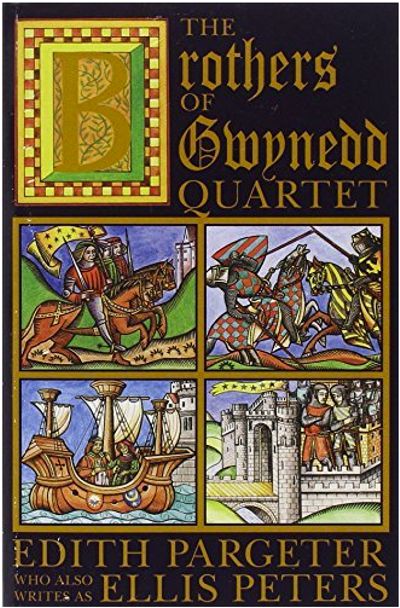
Blurb
Four Books Comprising Sunrise in the West, the Dragon at Noonday, the Hounds of Sunset, and Afterglow and Nightfall
The story of Llewelyn, first true Prince of Wales, is the history of medieval Wales in dramatic and epic form.
Llewelyn’s burning vision is of one Wales, united against the threat of the English. But before he can achieve his dream, he must first tackle enemies nearer home. All three of his brothers hamper his efforts to create an independent state. The best-loved of the three, David, brought up throughout his childhood at the English court, restless, charming, torn between two loyalties, is fated to be his brother’s undoing. Despite the support of his beloved wife Eleanor, Llewelyn finds himself trapped in a situation where the only solution is his own downfall and a tragic death…
My Review:
Four books in one tell a story that would certainly be incomplete if broken up. We have four brothers, and it was the second eldest who managed to claim the lordship—mostly because he was the only one who dared strike off on his own when his mother and siblings went to King Henry III’s court. Llewelyn, named after his great-grandfather Llewelyn Fawr, Prince of Gwynedd, followed his own destiny, which led him to become Prince of Wales—but not right away. His youngest brother David—gorgeous, fascinating, inscrutable, and tortured—adored him, but failed to live up to Llewelyn’s, and his own, expectations. As a result, David betrayed him not once but twice over the years, joining Prince Edward who had been his childhood playmate. However, he gained Llewelyn’s forgiveness both times, which he knew he didn’t deserve. This story is told in first person by Samson, their dearest friend, who was born on the same day as Llewelyn and shared a wet-nurse (his mother) with David. Both brothers trusted Samson implicitly and he was involved in every aspect of Llewelyn’s history. During Henry III’s reign we live through the traumatic days of Simon de Montfort’s rebellion and his tragic end—but not before he promised his daughter to Llewelyn in marriage:
Earl Simon leaned to him and laid both hands upon his shoulders, and kissed him upon the cheek with the kiss of kinship, for acceptance and blessing.
‘My daughter is yet young,’ he said, ‘not quite thirteen years. But there is no man to whom I would more gladly confide her than the prince of Wales, and none among all those not my sons I would so joyfully welcome as a son. With all my heart I promise her to you, and will record the vow here and now, if you so please.’
Llewelyn was destined to wait a long time before this wedding would come to pass. Meanwhile, we slide into Edward I’s reign, and Llewelyn did his best to establish a constructive relationship between England and Wales. But it was not meant to be. Edward was too callous, too unfeeling, too greedy to let Wales exist as a separate principality and matters went from bad to worse. And Llewelyn was beset by the unfaithfulness of his own countrymen, who had yet to understand the concept of nationhood. For a short while it looked like all would go well, but even then Llewelyn had to bow down to King Edward’s unforgiving policy, and his grasp on Wales began to slip away. It’s a sad story, but almost inevitable considering the country’s background. Edith Pargeter gives us a thoroughly researched history, and though at times she becomes a bit long-winded, the book is well worth perusing to the end.

Amazon US: https://www.amazon.com/Brothers-Gwynedd-Quartet-Comprising-Afterglow/dp/0747232679/


