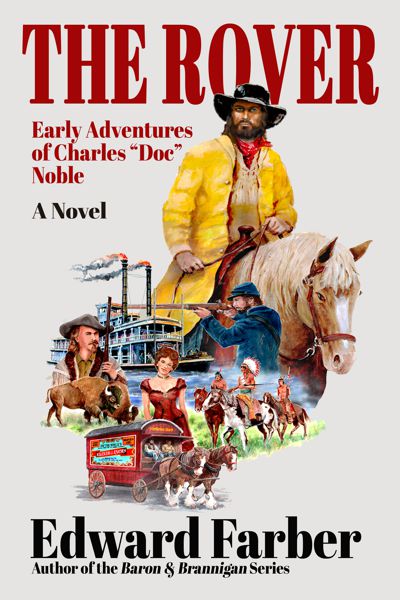
It’s 1864 and the Civil War is still ablaze. Young Charles Noble, a veteran of three years in the Union Army and not yet 21, limps off the battlefield to save his wounded leg from the surgeon’s saw. Believing that the Army considers him a deserter, he decides to lose himself in the wild, frontier towns of Kansas where the railroad is steadily bringing civilization westward. Driven by nightmares of the war, a desire for adventure and a growing need to roam, he travels under the alias, Charlie Bell, and becomes involved in a series of fateful encounters including serving as a crew member aboard a Mississippi riverboat, working on the railroad, meeting Bill Cody, joining him as an army scout and buffalo hunter, performing in a traveling tent show, even being hired as a bodyguard in a brothel. These youthful escapades shape him into “Doc” Noble, the spellbinding character we meet later in life in author Edward Farber’s popular novel, Baron & Brannigan and reward you with a spirited tale of adventure along the way.
Who is Charles “Doc” Noble?
My protagonist in The Rover, Early Adventures of Charles “Doc” Noble is not yet 21 when we first meet him in Chapter 1, but I knew him long before, when he was Doc Noble, the aging, paripatetic proprietor of a traveling medicine show in the 1890s. Sounds odd, doesn’t it? To explain, I created him as an important character in my earlier novel, Baron & Brannigan, Book 1. The new book, The Rover, is a prequel to that novel. Actually, he first appeared in a short story I wrote entitled “Elixir of the Incas” published in the August, 2006 edition of Cricket, a popular children’s magazine. That story was the seed out of which my novel series sprouted and the real birth of my character, Charles “Doc” Noble.
It has always been a mystery to me how my fictional characters emerge and become “people” with names, physical attributes, personalities, and personal histories. When I brought Doc Noble to life in the Baron & Brannigan novel, I stitched him together out of information about medicine show proprietors gleaned from much library research. More on that later. In Doc Noble’s case, I did give him a little backstory, but after the novel was completed and published, I still wondered what circumstances in his early life would have turned him into the traveling man he was in the novel. Out of that curiosity came The Rover, Early Adventures of Charles “Doc” Noble.
Research, Research, Research
In order to satisfy my curiosity, I needed much research. For me, research is most important in writing a historical novel. I love writing, and I have a definite fondness for research as well-discovering the historical trappings for the action in the book. We authors are telling a story, but the setting for that story must be true to the time in which it takes place in every way. Of course, we might take liberties in speech patterns because if we copied the precise way people spoke and wrote in some distant past, it could sound stilted and strange to a reader in the 21st century. In dialogue, we make sure that we don’t use words, terms, and slang that were not in use at the time.
We first meet Charles Noble as a Union soldier involved in a Civil War battle in Georgia as part of General Sherman’s March to the Sea. This required a ton of research, including weaponry, local battles around Atlanta, railroads, steamboats and other details that appear in the narrative and dialogue. Much more research was needed as I delved into Noble’s moves following the Civil War. I really was not very familiar with that period in U.S. History including information about the States, Territories and transportation of that era.
Working on the Railroad
Railroads, especially, play an important role in the novel as they did in our country’s history. In the eastern and southern parts of the United States, railroads were well-established, connecting all sections of that portion of the country. In the post-Civil War years, there was a rush to connect the settled West Coast region with the rest of the country via rail lines. Some of the story is well-known, especially the meeting of the rail lines at Promontory Point, Utah, in 1869 to establish the first Transcontinental Railroad.
To reach that historic moment, however, years of railroad construction took place, a good part of it across the great prairie which composed a large portion of the central part of the country west of the Mississippi River, especially in the state of Kansas. Kansas became a state in 1861. Prior to that, it was a territory, part of the vast Kansas and Indian Territory established by Congress in 1854. Here lived the tribes who had been in the area for many years, as well as tribes who were moved there from states east of the Mississippi after the Federal government’s Indian removal policy in 1830. History shows how complicit our government was in the subjugation of Native Americans as well as the near extinction of the buffalo herds that roamed the plains.
Surprise…The “Wild West” was in Kansas
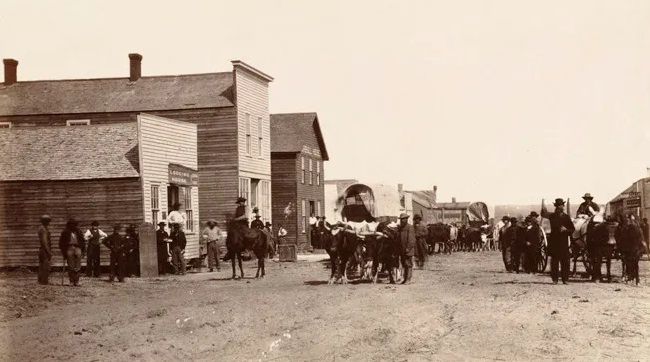
If you thought the Wild West of movies and TV was in Colorado, Wyoming or further west, think again. It was in Kansas! In 1866, the Union Pacific Railway, Eastern Division, was building the railway heading west across the Kansas plains, having already connected Kansas City, Lawrence and Topeka. End-of-track at that time was Junction City, about 127 miles from Kansas City. West of there was open prairie where a number of Army forts were located to combat increasing Indian unrest. Young Charles Noble joins a railroad building crew here after his escape from the battlefields of the Civil War.
From Junction City, track was laid to what became the next big rail junction, Abilene. That new town grew into a wild, untamed cattle town where Texas longhorn cattle were driven to be shipped east. In no time at all, saloons, gambling halls and brothels proliferated to meet the demands of the visiting Texas cowboys. It set the pattern for other new towns along the path of the railroad.
Laying track was arduous and time-consuming but steady, and by the autumn of 1867 the railroad towns of Ellsworth and Hays, Kansas were established, both near Army forts. They also became wild towns like Abilene and play a role in The Rover. Another Kansas town, along the Atchison, Topeka, and Santa Fe rail line, is well-known to western lore enthusiasts as Dodge City, home of TV’s Marshal Dillon and Miss Kitty’s Long Branch Saloon and real western personalities including Wyatt Earp and Bat Masterson. While some may think that the Wild West was further west, it really had its beginnings on the midwestern Kansas plains.
Buffalo hunting with Buffalo Bill Cody
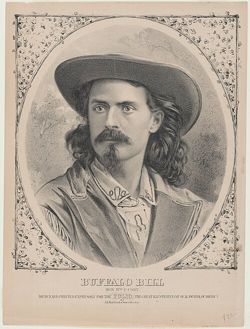
The most well-known historical personality of the era is William Cody, known world-wide then and today as the famous Buffalo Bill. In numerous books and movies, including his own autobiography, his exploits as a showman have been recorded. His Wild West Show was a huge success, touring widely in the U.S. and Europe.
Before he became a popular showman, however, Bill Cody was a legitimate frontiersman. At age 11, he was working for a freight company and subsequently held jobs as a trapper, teamster and prospector. At 17, he joined the Union Army in the Civil War and later served as an army scout in the Indian Wars. In the years 1867 and 1868, he was employed as a hunter to supply meat, mostly buffalo, for the railroad crews. His exploits at this time earned him the name Buffalo Bill. He was a young man in his 20s and already an experienced plainsman with notable achievements, a true western hero.
Bill Cody, in his real role as a buffalo hunter, meets my fictional protagonist, Charles Noble, and thus becomes a character in The Rover. Ittruly was fun researching the life of Buffalo Bill Cody as well as the skills of a buffalo hunter. What is depicted in the book about buffalo hunting and Bill Cody is as close to reality as possible even though all the scenes where Cody and Noble interact are total fiction.
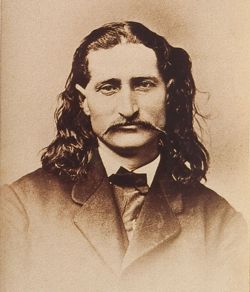
Among other “real” frontier characters who interact with Charles Noble in a minor way are the legendary James Butler Hickok, better known as Wild Bill Hickok, and Wyatt Earp. Hickok actually was a good friend of Bill Cody and served as deputy marshal for the town of Hays City, home at that time for Lt. Col. George Custer and his wife, Elizabeth, the Bill Cody family, Hickok, and his friend, Martha Jane Canary, better known as Calamity Jane. Hickok, like Bill Cody, had been an army scout. While Cody went on to world-wide fame, Hickok who had a well-founded reputation as a lawman, also was a cattle-rustler, gambler and gunslinger, and eventually was shot and killed while gambling in a saloon in Deadwood, South Dakota. He was 39 years old.
Research sometimes rewards the researcher with a serendipitous find. In my case, I was researching Missouri towns along the Kansas border in existence around the year 1870, when I discovered that Wyatt Earp at age 21 had been a constable in Lamar, Mo. I did use that fact in one scene in the book. You never know what you might uncover when you begin researching.
Medicine Shows, a form of popular entertainment
Most of my research of medicine shows of that era took place prior to writing the Baron & Brannigan series. What I learned shaped the character of Charles “Doc” Noble. A medicine show proprietor of that time was primarily a showman with a gift for persuasive elocution, a gift of gab. Actually, most were glib charlatans, pedaling worthless “medicine” as a cure-all. “Won’t cure ‘em, but won’t harm ‘em either,” as Doc would say, since the concoctions being pedaled were usually harmless ingredients plus an ample amount of alcohol. In some instances, however, a “medicine” could be quite harmful, some containing cocaine, morphine, opiates, even heroin. There was no governmental regulations at the time.
Also, as Doc would say, “It’s entertainment that sells the medicine.” To gather an audience, traveling medicine outfits would offer a show of some kind, almost any kind, since entertainment was rare in small towns, and small towns offered the kind of unsophisticated audiences most likely to become customers. In The Rover, young Charles Noble discovers a latent ability to perform before an audience, one more characteristic that shapes his future.
I probably spent more hours doing research than writing my novel, The Rover, but since I enjoy both, it presented no problem. As a result, I satisfied my own curiosity about how a young Charles Noble became Doc Noble, the character I created in an earlier novel, and I learned a lot about that time in American history. And that’s why I like to write (and read) historical fiction.
Amazon US: https://www.amazon.com/Rover-Early-Adventures-Charles-Noble-ebook/dp/B0FSKTXW3Y?
Meet Ed Faber
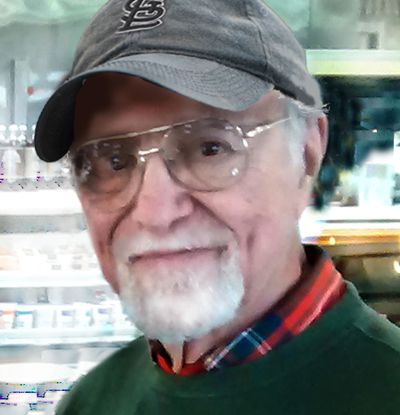
After a lifetime of writing mostly non-fiction for newspapers, magazines, advertising and public relations, Ed Farber returned to his first two loves, writing fiction and art. He is the author of three novels in the Baron & Brannigan Series: Baron & Brannigan, Book 1, Song and Dance; Brannigan’s Quest, Book 2; and The Rover, Early Adventures of Charles “Doc” Noble. Also, he has written a collection of short stories, Echoes of Clara Avenue, and a humorous memoir, Looking Back with a Smile, both available as EBooks at Amazon. An accomplished artist (he designed and painted the covers for his books) his work has appeared in numerous exhibitions and hang in private collections. He lives, writes and paints in St. Louis, MO.
Connect with Ed
Author Website: www.EdFarberAuthor.com
Art Website: www.edward-farber.pixels.com
Facebook: www.facebook.com/edward.farber/
Amazon Author Page: https://www.amazon.com/stores/Edward-Farber/author/B007BXTNF2
Goodreads: https://www.goodreads.com/author/show/13525209.Edward_Farber
Draft2Digital: https://draft2digital.com/book/662633


