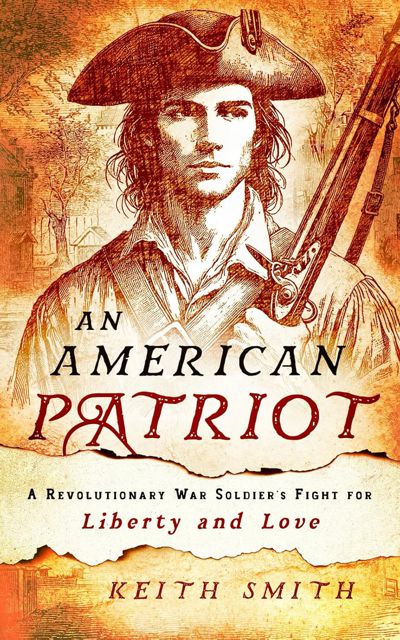
An American Patriot is a historically grounded novel inspired by the true life of Thomas Elwell, a Revolutionary War soldier and the author’s fifth great-grandfather, whose story survived only through fragments of military records—until now.
The narrative unfolds through a deeply personal frame: a son seated at his father’s graveside, speaking aloud the story he wishes he could have shared in life. As the author recounts Elwell’s journey from the colonial frontier to the battlefields of the American Revolution. Past and present quietly intertwine, reminding the reader that history is not only something we study, but something we inherit.
Drawn from years of genealogical research and grounded in documented events, the novel traces Elwell’s evolution from an adventurous young man into a soldier shaped by hardship, loyalty, love, and loss. The story moves through pivotal moments of the Revolutionary era while never losing sight of the human cost borne by ordinary people whose names rarely appear in textbooks.
Blending careful historical detail with imaginative reconstruction, An American Patriot honors the countless men and women who helped secure American independence—and the generations who carry their stories forward. Written for readers who value accuracy, reflection, and narrative depth, this is a novel about legacy, memory, and the enduring bond between past and present.
Excerpt: Chapter 1
A New Endeavor
Cumberland County, NJ August 1774
“Have you thought through this?” David Elwell stood just outside his modest dwelling on his tobacco farm as he asked his younger brother this question.
“I have,” Thomas replied confidently as the two of them began a serious and life-altering conversation.
Now twenty-three years old, Thomas had completed his apprenticeship as a cooper, making wooden casks and tubs. He’d learned his trade well and assisted his father in running a gristmill before moving from the familiar surroundings of Salem, New Jersey, to the edge of the frontier in Berkeley County, Virginia, where he lived with his cousins, the Van Meters. After living with them for a year on their homestead at the edge of the frontier, Thomas had made other plans—plans that warranted a trip home to inform his family about.
Thomas succinctly informed them that he intended to go with his lifelong friend, Levi Hall, to join the British Lord Dunmore’s militia in the conflict against the Shawnee and Mingo tribes. The new settlers had moved into the Indians’ territory, which had led to a battle over the land. Thomas had no political inclinations, but he said he wished to stake a claim to some of the land that was in dispute just south of the Ohio River.
What was initially unspoken—but well-known amongst his family—is that Thomas also craved adventure.
None of his family members had taken well to this news. A bit in shock, they all parted for the night, but now David was picking up the conversation the next day, after a fitful night of sleep. David was worried, and his concern began with how their mother would accept her son going off to battle.
“You, Jacob, and the others will take great care of Mother,” Thomas reassured his brother David. “You have always known that my tem perament is unsuited for either farm labor or the sea. I supported Father’s business the best I could, but his debts were too great. Selling the gristmill, as he spelled out in his will, freed us from his debtors, while it also freed me of my need to continue in a trade that does not fit my nature.”
“I understand, Brother,” David shook his head in concern. “But go to war? Should you meet with tragedy, Mother would be devastated. And to what end? To support a governor in his fight against the Indians, when it was the Crown that broke the treaty to stay out of the Indian territory?” he added, “Dunmore is a lackey for the Crown, and nothing good can come of you siding with him in any of his affairs.”
No one in their family had never been concerned about political affairs, seeing little daily relevance in the decisions made by England. Thomas was therefore surprised that his older brother even knew much about the Indian crisis on the frontier, but he gave a faint shrug to acknowledge David’s concerns.
“I neither know nor care about the squabbles between Dunmore and the Indians,” Thomas admitted. “But you know how I have longed to travel to unknown places. Seeing the lands south of the Ohio River has been a particular dream of mine. Father made it sound intriguing when he forbade us to venture there. Have you no curiosity about what lies beyond?”
David’s face remained unchanged, so Thomas continued.
“As far as Mother is concerned, I will speak with her again before I leave in order to assure her I will remain well.”
David’s concern still didn’t abate. Thomas realized he must do more than just speak to their mother. First, he must reassure his brother of such well-being.
“Besides, Levi will keep me safe. His protective and colossal size makes him a far easier target for any enemy arrows,” Thomas said light heartedly about his friend.
Thomas stood at just over five-feet, six-inches tall, and his lean frame hadn’t yet filled out to that of a grown man. Levi Hall, in contrast, was six-feet, four-inches in height and bulky in frame. Thomas once teased Levi that he looked more like an ox or a draft horse than a human.
“It seems you have made up your mind,” David sighed in resignation. “And where is Levi now?”
“He arrives at the courthouse on the morning coach,” Thomas replied. “Pulling the carriage or riding inside, I do not know which,” he joked again.
While the brothers spoke, their mother stepped outside of the house to join them.
“Thomas, I beg you not to do this,” she said. “Your father—”
Thomas cut her off. “Wanted you to live the rest of your days with neither debt nor worry . . . and in the company of family,” he finished for her. “But even in death, Father accomplished the first when we sold the business and paid his debts. Your loving sons—David, Jacob, Uriah, Isaac, Samuel, and their families— will look in on you. But as for that remaining issue of living without worry, I implore you, Mother, to trust my safety and well-being to Providence and our old friend, Levi, who will be my ever-present protector. Just as Levi and I took care of one another in our youth, we will do the same throughout this adventure to the west.”
Summoning the same courage that had been required by generations of frontier women since the founding of the colonies, Susannah relented. “If harm finds you despite Levi’s best efforts, then I will accept that Divine Providence has called you home for a reason unknown to me. Stay in the shadow of your friend, keep your head low, and pray the Lord’s safekeeping.”
“I shall, Mother,” he said, embracing Susannah. “But until I leave, we shall talk of happier days passed and of more joyful ones still to come.”
Amazon: https://www.amazon.com/dp/B0GKCSMYZW?
Meet Keith Smith

Keith Smith is a devoted student of history whose passion for genealogy has shaped the way he understands both the past and himself. For Keith, tracing family lines is far more than compiling names and dates. It is a journey into the lives of the people whose choices and experiences helped shape his own story.
His interests are rooted in the colonial period, the American Revolution, and American military history. Guided by a commitment to historical accuracy, Keith draws on years of genealogical research and visits to places where his ancestors once lived, walked, and fought to better understand their lives and preserve their stories with integrity, depth, and respect.
Connect with Keith
Website: https://www.keithsmithauthor.net/


