
Early 1942: the fate of the Suez Canal and access to Middle East oil hangs on the fate of an island just 17 miles long by 9 miles wide: Malta.
Determined to destroy the British forces threatening Rommel’s supply lines, the Axis powers drop more bombs on Malta than London endured throughout the Blitz. The population is forced underground, while the RAF struggles with inadequate resources to fend off defeat. Meanwhile, Britain’s Atlantic lifeline is fraying….
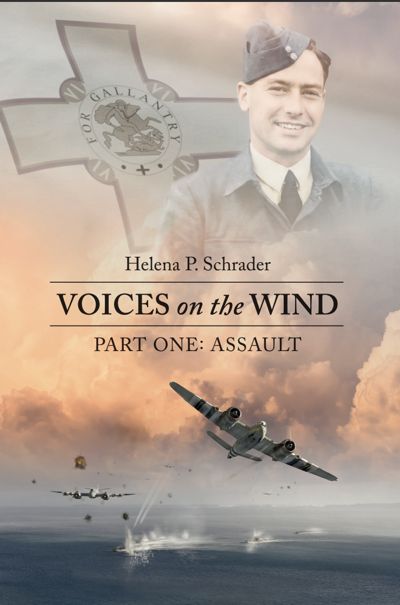
Voices on the Wind follows the fate of four of Malta’s defenders: Senior Intelligence Officer and former Battle of Britain ace, W/Cdr “Robin” Priestman; WAAF SigInt Officer Candice Weld, sent out from Bletchley Park to “man” the only X-machine outside the UK; F/O “Ned” Nettleton, a Beaufort torpedo bomber pilot engaged in suicidal attacks against enemy shipping; and Chief Officer Stevie Mackay of the British Merchant Navy, fighting to keep Britain’s own lines of supply open.
The Nurse of the Mediterranean
Appalling casualties were one of the defining characteristics of the First World War. Between nine-and-a-half and ten million men were killed in combat or as a direct result of wounds. Seared into collective memories is the phenomenal cost of individual battles that ultimately achieved nothing. For example, on the first day of the Battle of the Somme, the British saw 19,240 of their troops killed, while the French sacrificed the lives of 162,000 men at the Battle of Verdun. Often overlooked in the statistics are the wounded, whose suffering went on long after the guns were silenced.
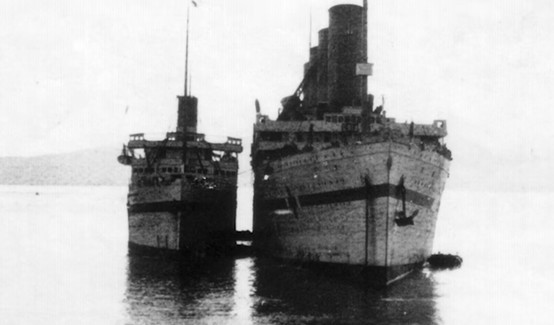
On the Western Front, Allied troops received initial care at field hospitals but were then sent “home.” Hospital trains brought thousands of injured troops back to the UK within just days of major battles. Those who had the misfortune to be wounded in distant theatres of war such as Gallipoli and Salonika, however, could not be repatriated for long-term care. Trapped as they were on a narrow strip of shoreline, the wounded stood a chance of survival only if they could be put upon hospital ships and taken ‘somewhere safe.’ The closest British territory to both Gallipoli and Salonika was the island of Malta — 830 nautical miles from Gallipoli and 580 miles from Salonika. The voyage took two to three-and-a-half days respectively. (Two British hospital ships at anchor.)
By May 1915, just weeks after the start of the Gallipoli Campaign, hospital ships were pouring into Grand Harbour, carrying thousands of ANZAC and British wounded. Overwhelmed by the unexpected ‘visitors,’ the Maltese authorities rushed to convert every halfway suitable large building into an emergency hospital. Primary schools in Sliema, barracks in Mtarfa and Floriana, and the venerable Auberge de Bavière, built by the Knights of Saint John, were all pressed into service. When these proved inadequate, tent cities were erected. By the end of 1915, Malta had over 25,000 hospital beds in 27 different locations.
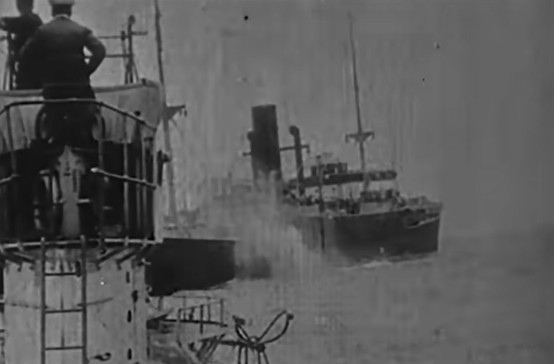
All those hospitals needed not just trained medical personnel and medicine, while the patients needed food, clothing, sheets, blankets and shoes. To keep wards and emergency rooms light, to keep hospitals warm, and to pump clean water in and sewage out, the island needed electricity and this meant the island also needed coal in vast quantities. All of those additional needs had to be brought in by sea — a sea increasingly infested with enemy U-boats. (Below a U-boat attacks an Allied merchant ship.)
Meanwhile, although the Gallipoli campaign was winding down, the Salonika campaign was only just starting. While an estimated total of 58,000 wounded from the Gallipoli front were brought to Malta for medical treatment, roughly 67,000 men were sent to Malta for medical treatment from Salonika. During the battle for Gallipoli, the bulk of the wounded were trauma patients; the casualties from the Salonika front were predominantly suffering from disease, particularly malaria, dysentery and frostbite. In addition, an increasing number of shell-shock cases were recorded. The latter were not fit to be returned to the front and required longer-term care, facilities that were also provided in Malta.
Transporting all those casualties to Malta was becoming a serious problem. Technically, the Hague Conventions should have protected hospital ships from attack. Provided they were clearly marked (painted white with large red crosses on them) and sailed fully illuminated at night, hospital ships were not supposed to be targeted. But mines can’t distinguish between warships, merchantmen and hospital ships — and the U-boats, in addition to sinking ships by gunfire and torpedoes, were also laying mines.
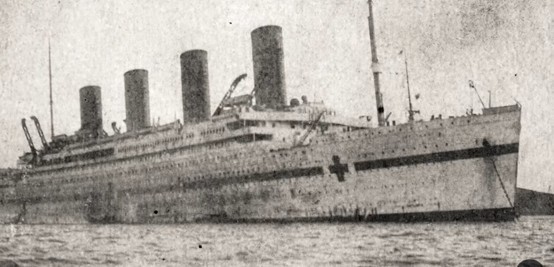
Already in February 1916, the Italian hospital ship Marechiaro struck a mine while transporting wounded Serbians evacuated after their bitter retreat through the wintry mountains of Albania. The British hospital ship Britannic, the sister ship of the Titanic, ran into a mine and sank in less than an hour on 21 November with the loss of thirty lives. Just two days later, another British hospital ship, the Braemar Castle, was damaged by a mine, but the captain managed to beach her. She was later repaired and refloated. (Below the Britannic in her livery as a hospital ship).
Although there were no casualties during the second incident, the risks were too great to ignore, and the Admiralty decided that hospital ships had to be escorted from then on. It was a wise decision. Shortly afterwards, the Germans declared ‘unrestricted submarine warfare,’ and all pretence of following the Hague Conventions was dropped. Henceforth, hospital ships, like the troopships and merchantmen, only sailed in convoy; all were painted in ‘dazzle’ camouflage and followed the same blackout protocols as warships.
Meanwhile, as the patients moved from emergency to intensive care, and began convalescence and rehabilitation, they still could not go ‘home.’ Indeed, even those who had recovered completely and were medically fit enough for active duty could not return to the front without crossing a hostile and dangerous sea. Valletta became crowded with men in blue hospital attire on ‘extended leave.’
All were in need of food, clothes and entertainment. Those released from hospital, whether temporarily or permanently, were in search of distraction, relaxation and entertainment. Malta responded by offering concerts, plays, opera and cinema, and by organising dances, sports matches and even horse racing. The recovering patients also visited the historical sites, swam in the warm waters, or went boating and fishing. In short, Malta offered the troops a welcome respite from the war that most remembered gratefully — but it wasn’t home.
Finally, in late 1917, the Admiralty acknowledged the fact that the Royal Navy was over-extended and not able to provide sufficient escorts to meet the needs of the sick and injured. The British Government concluded that hospital facilities had to be located closer to the Italian and Salonika fronts to reduce the risks to patients and staff and to ease the strain on the Royal Navy. New hospitals were located in mainland Greece and Italy. Medical staff was transferred to the new facilities, and Malta transitioned back to a Royal Navy base rather than a medical hub.
Left behind, in addition to the memories, were five Commonwealth graveyards with nearly 3,000 graves marking the men who had died from their wounds while in Malta during WWI.
Universal Buy Link: https://books2read.com/u/4DegDe
Meet Helena P. Schrader

Helena P. Schrader is the author of 21 historical novels and six non-fiction history books. She earned a PhD in History from the University of Hamburg and served as a U.S. diplomat in Europe and Africa. She has won numerous literary awards, and two of her titles—Cold Peace, the first book in the Bridge to Tomorrow series on the Berlin Airlift, and her Battle of Britain novel, Where Eagles Never Flew—achieved Amazon #1 Bestseller status in aviation and military historical fiction.
Schrader masterfully blends meticulous historical research with compelling storytelling. Her success can best be measured not by the many awards or positive reviews, but by the fact that witnesses of the history she describes praise the authenticity of her works. Battle of Britain ace, W/Cdr Bob Doe enthusiastically declared that Where Eagles Never Flew got it “smack on the way it was for us fighter pilots.” Traitors for the Sake of Humanity: A Novel of the German Resistance won recognition for its extraordinary sensitivity to a complex topic from the survivors of the military conspiracy against Hitler and the widows of some of those executed.
The dramatic siege of Malta in WWII attracted Schrader’s attention years ago, and she has visited the island several times to conduct research, visit the important sites, and gain a greater understanding of the people. As she became drawn deeper into the material, the temptation to combine a novel about the siege of Malta with another of her lifelong loves, the British Merchant Navy, became irresistible. Schrader has been an avid sailor all her life and served as a petty officer in the British Merchant Navy on sail training ships in her youth.
Connect with Helena
Website: https://helenapschrader.com
Facebook: https://www.facebook.com/helena.p.schrader.7
Bluesky: https://bsky.app/profile/helenapschrader.bsky.social
Quora: https://www.quora.com/profile/Helena-Schrader-1
Substack: https://hpschrader.substack.com/
BookBub: https://www.bookbub.com/helena-p-schrader
Goodreads: https://www.goodreads.com/author/show/1785954.Helena_P_Schrader
Amazon Author Page: https://www.amazon.com/stores/Helena-P.-Schrader/author/B0024JCLUW


