
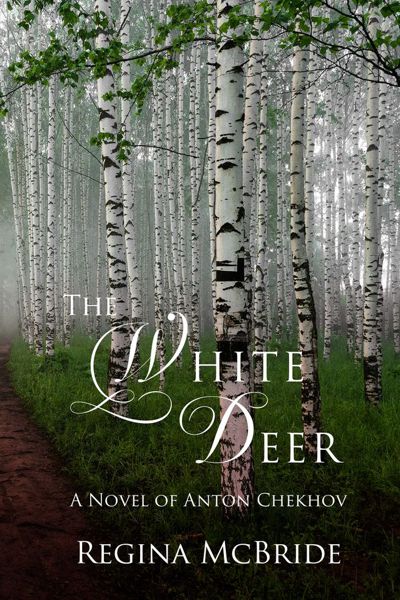
In the summer of 1879, on his way to Moscow to study medicine, 19-year-old Anton Chekhov, from a bankrupt merchant class family, stops to spend a restful few weeks in the Ukrainian countryside, staying with his friend, Dr. Mitrofan, who is worried about Anton’s lingering bronchitis. It is here that Anton meets Vera Denisova, also 19, a budding actress, the daughter of theater aristocrats from Volkhov, a neighboring estate. The two spend much of their time wandering Volkhov’s vast property, hoping for a glimpse of a white deer that has been spotted in the back acreage.
As they grow closer, Vera confides in Anton about her secret romance and heartbreak over Petya, a servant her age who was gifted at drawing and who she helped to acquire an apprenticeship as a draughtsman in order to leave servitude for good. Anton is fascinated by her obsession, and a triangle forms between Vera, Anton, and the absent Petya. Anton, too, shares his secrets with her, his conflicted relationship with his indigent family and his frustrated wish to publish stories. Surreptitiously through Anton, Vera learns the truth about her family’s declining financial situation and the impending loss of her beloved childhood estate. Together in the long, extended light of summer days, Vera and Anton struggle to come to terms with their feelings for each other and the new profoundly changed world that is waiting for each of them at summer’s end.
The final section of the novel charts the correspondence between Vera and Anton over the next two decades. Vera has become a successful actress and Anton, a doctor who treats peasants for free, has more than realized his ambition as a writer.
In a final letter to Vera before his death at 44 of tuberculosis, Anton reveals that his play, The Cherry Orchard, was inspired by his time with her at Volkhov.
Excerpt
I picked up her round wooden hairbrush, which sat on top of the dresser. She brushed her own hair and Sasha’s with this brush and the soft white bristles were enmeshed with long blonde strands of hair. For a long time now my mother and Sasha shared a closeness that excluded me, though Sasha was often impatient, even angry with her. Our mother reacted very quietly to Sasha’s irritability, collapsing a little into herself, and I think Sasha may have felt guilty sometimes about her anger, maybe even confused about where it came from, but seemed unable to curb it.
“Will you, Mama?” I asked, holding out the brush.
She looked vaguely startled. I knew she didn’t want to be torn away from whatever she was thinking about, but she nodded and I walked back into the front room and sat on the red velvet couch unpinning my hair and spreading it over my shoulders. She followed, stood behind me and brushed.
On the wall above the fireplace hung a framed map of Russia, which was practically all Siberia, all white uncharted territory barely marked. And then there was the crowded far western side where Ukraine was, Baltic Russia hinging itself to Eastern Europe and Finland and Lapland.
Until my mother was sixteen, she had lived with her family at a southernmost point of Ukraine on the edge of the Black Sea, which was clearly marked on the map at the bottom of the western side of the continent.
To engage my mother I resorted to asking her questions about things I already knew the answers to, things I knew she would be happy to repeat.
“What is the name of the place south across the Black Sea, the nearest shore to where you lived when you were a girl?”
“Constantinople,” she said, almost brightly.
My mother had spent the early years of her life breathing moist, salty air, gulls riding the spring and autumn winds.
“And you had a pet goat, didn’t you, Mama? What was her name?”
“Her name was Dunya.”
“She used to unlock the gate with her teeth,” I said.
“Yes,” she laughed softly. “I am convinced, Vera, that she understood everything I said to her. She was such a clever goat.”
“And she had golden eyes,” I said.
“Yes.”
“And you had a red parasol.”
“One summer, the sun faded it pink.” She laughed softly again.
The brush slowed in my hair. “The paradise of childhood,” she said, “didn’t last.”
Her family had been Old Believers, something they’d been, for generations, persecuted for. Sasha had explained to me what our mother had left unclear. Our mother’s father, our grandfather, had been a writer, Alexander Belanovsky. He wrote a poem in which he claimed that the White Czar of the holy city in Russia’s eastern lands was the only true czar of Russia. For this, everything our grandfather had written, all seven of his books, were banned and destroyed. He was arrested and sentenced to forced labor in the silver mines of Nerchinsk and his family accompanied him into Siberian exile. Once they reached the Vladimirka Road, our grandfather, who was an epileptic, was taken in chains by cart with a group of other convicts. Our grandmother, mother, and her older half- brothers, Boris and Dimitri, followed in a separate cart.
The weather had often been bad, but they were luckier than most. My grandfather at least was in a cart, while they often passed people who were chained to each other and wearing only rags, walking into exile. But even in the carts it took months to reach Lake Baikal, in a mountainous region of the Siberian forest, and it would have taken even longer to reach Nerchinsk. They still had weeks of traveling ahead but had stopped for the night. It was October and the winds were cold. Our grandfather underwent a seizure, and in his frenzy, choked himself with his chains.
The family remained grief stricken at the lake. A sect of Old Believers, the Children of the White Czar, had been camping nearby, celebrating the Festival of Kupala since the summer solstice. Thousands of pilgrims had been there but had all eventually left. This group of fifteen or twenty were about to travel north to try and reach Evankia, one of the most remote areas of Russia and the refuge for some sects of Old Believers. In his grief, Dimitri’s religious fervor grew intense and he persuaded them to join the sect and follow the wanderers northward through taiga. This holy pilgrimage was rarely undertaken, except by the most devout.
They were stranded on flooded roads and tormented by furious winds, surviving mostly on powdered tea and dry bread. They tried to follow the river, where they were able to glut themselves on sterlets, which were easily caught. The cold began to get the better of them. Dimitri had repeated visions of a young woman in a pale blue dress leading a reindeer and pointing the way through the trees. There had been snow flurries all along, but one morning they awakened and the entire world was white, not a single branch visible on any tree.
Universal Buy Link: https://books2read.com/u/mvaor8
Meet Regina McBride
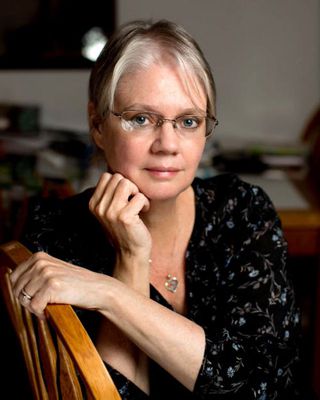
Regina McBride is the author of eight books. The White Deer ~ a novel of Anton Chekhov is her sixth novel. She is also the author of one memoir, Ghost Songs, and one book of poetry.
Her novel, The Nature of Water and Air, was a Booksense Pick (Independent Book Stores Selection), a Barnes and Noble Discover Great New Writers book, and a Borders Original Voices choice. It was optioned for a film. Her books have been translated into five languages.
A recipient of fellowships from the NEA and the New York Foundation for the Arts, Regina lives in New York City, where she taught fiction writing for thirty years at Hunter College and continues to teach privately.
Connect with Regina
Website: https://www.reginamcbride.com/
Facebook: https://www.facebook.com/profile.php?id=100010471921681
Instagram: https://www.instagram.com/reginamcbride/
Amazon Author Page: https://www.amazon.com/stores/Regina-McBride/author/B001IXMGLE
Goodreads: https://www.goodreads.com/author/show/71686.Regina_McBride