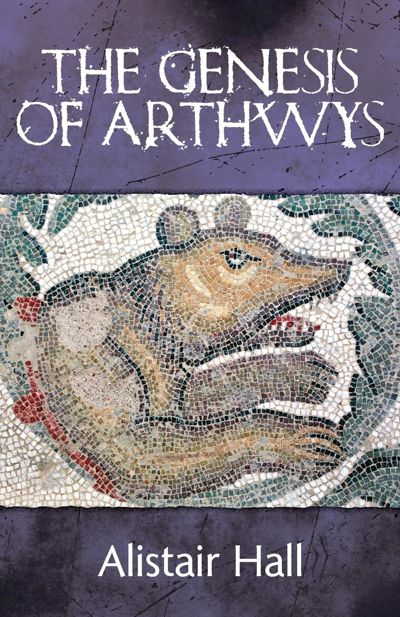
AD 412. Britannia is breaking apart.
The Roman legions are gone, leaving rival warlords to fight for control as Saxon forces push relentlessly inland.
In the north, mighty war leader Coel Hen has defended the frontiers for decades. But now he is dying, and with him, the fragile unity of his kingdom begins to collapse, threatened by civil war.
Talhaearn, Coel’s adopted son, is forced into a role he was never meant to inherit. To survive, he must unite Coel’s divided family, command a fragile militia, and protect the young prince Arthwys, the boy who may become Britain’s greatest war leader.
But loyalties are shifting, and betrayal is close.
Here, survival demands more than strength. And not all loyalties will hold.
Set in the brutal realities of post-Roman Britain, Genesis of Arthwys reimagines the origins of the figure later remembered as King Arthur, not as myth, but as a commander forged in war.
Fifth century Britain bears little resemblance to the world most people imagine when they think of King Arthur.
For nearly four hundred years, Roman rule had dominated the island, but it had never been a truly settled territory and Britain had always proved difficult to control. In the north, Rome had faced periodic resistance and incursions from peoples including the Brigantes, Caledonii and, later, the Picts, contributing to the militarisation of the frontier and the construction of Hadrian’s Wall.
Empire-wide, treachery and intrigue resulted in a long list of bloody civil wars, undermining available manpower and debilitating the Roman Empire’s former military might. This led to a reliance on foreign mercenary troops, known as barbarians, and these tribes quickly grasped the opportunity to gain power from within the imperial system.
By the early fifth century, effective Roman rule in Britain had come to an end. The provincial administrative structure largely collapsed, and the cities of Britain were left to undertake their own defence.
At first, some Britons hoped Rome might return, possibly under the direction of a more vigorous emperor, but the crisis deepened, and the barbarian tribes grew stronger. Those communities in the south and east were left incredibly vulnerable, with no mobile field army to protect their conspicuous wealth from seaborne Saxon and Frankish raiders.
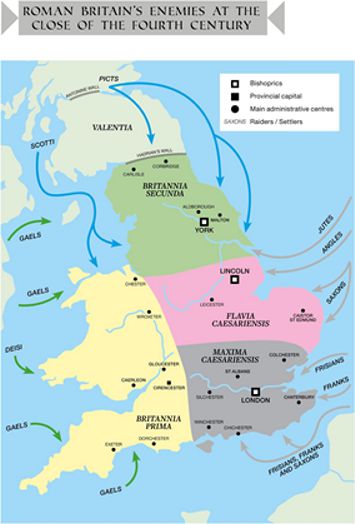
It was during this period of uncertainty that northern warlords and regional rulers emerged as successors to Roman military authority, raising forces to defend themselves against the Picts, Scotti, Saxons and, sometimes, each other.
Coel Hen, meaning ‘Coel the Old’, is an enigmatic and intriguing figure preserved in heroic poetry and the genealogies of northern Britain. In Welsh genealogies he appears as the ancestor of several important northern dynasties. His name is also known in some traditions as Godebog, or Guotepauc, meaning ‘Protector’. Intriguingly, he has sometimes been suggested as the inspiration for the nursery rhyme character Old King Cole, although this connection remains speculative.
His descendants, collectively known as the Coelings, include some of the best-known rulers of the Old North, the Brythonic-speaking territories of what is now northern England and southern Scotland.
Among them was Urien of Rheged, celebrated in the sixth-century poetry attributed to Taliesin. The surviving Welsh poetic and genealogical traditions offer tantalising glimpses of the rulers and dynasties associated with northern Britain after Rome. The genealogies associate Coel’s descendants with northern kingdoms including Rheged, traditionally located in northwestern Britain, and Elmet, centred in what is now Yorkshire.
Coel Hen’s role may have mirrored the Roman military office of Dux Britanniarum (Duke of the Britons), the commander responsible for the northern frontier. One possibility is that military authority passed into the hands of Roman-experienced British military commanders as imperial control weakened.
My own research explores whether Coel’s position might have developed from arrangements established during the period of Magnus Maximus, the Roman commander proclaimed emperor in Britain in AD 383. This would have made Coel Hen the last military general to command the northern frontier from key bases like York and Malton. Devolving military power like this represented a progressive sub-Roman strategy to fill the defensive vacuum, using native, Roman-experienced military commanders to control frontiers with fewer imperial troops.
Although the historical evidence is fragmentary, these possibilities offer a fascinating picture of how Roman military traditions may have survived and evolved in the kingdoms that emerged after imperial rule.
One of the most important sources for the traditional genealogies of the northern rulers is the Bonedd Gwŷr y Gogledd, or The Descent of the Men of the North.
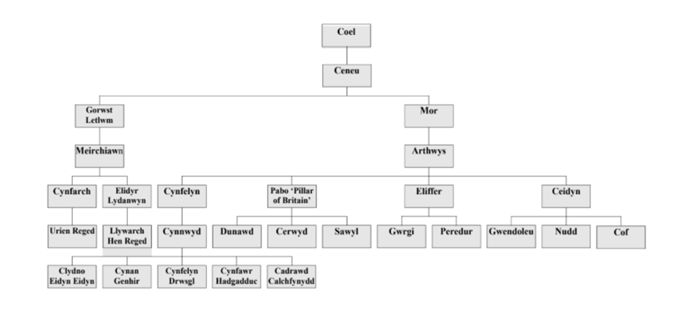
Compiled centuries after the events it describes, this Middle Welsh genealogical text preserves traditions concerning the descendants of Coel Hen and Dyfnwal Hen of Alt Clut, or Strathclyde.
As the chart shows, Arthwys appears in the traditional genealogy as the son of Mor and great-grandson of Coel Hen.
The genealogies suggest an extensive network of related ruling families across northern Britain. Such relationships may have created both political alliances and rivalries as territories and authority passed between generations.
However, these texts were compiled long after the period they describe, and the absence of contemporary corroborating evidence means that we cannot be certain when many of these figures lived or what roles they played.
There are numerous proposed candidates for the historical figure behind King Arthur, but surviving fifth-century sources are scarce, and no one identification has achieved general acceptance.
My own research, explored in my nonfiction book Searching for Arthur… Finding Arthwys, considers whether Arthwys, great-grandson of Coel Hen might have contributed to the origins of the Arthurian legend.
It was this research, and the turbulent world of northern Britain following the end of Roman rule, that provided the inspiration for my historical novel Genesis of Arthwys.
Rather than beginning with the familiar world of Camelot, knights and chivalry, I wanted to explore the political rivalries, shifting loyalties and military struggles that might have shaped the life of a British war leader in the fifth century.
The novel begins in AD 412, with Coel Hen approaching death and his family facing an uncertain future.
Through Talhaearn, Coel’s adopted son, the story explores the personal consequences of a kingdom threatened by division and invasion. Talhaearn must navigate competing ambitions within Coel’s family while protecting the young Arthwys, whose future remains uncertain.
The story continues in Rise of Arthwys, the second novel in the Arthwys of the North series, as the struggle for power and survival intensifies in a Britain transformed by the collapse of Roman authority.
The historical record offers only fragments of the lives of the men and women who lived through these turbulent centuries. Their ambitions, loyalties, fears and personal struggles are largely lost to us.
Historical fiction allows us to explore those gaps, imagining the human stories behind the surviving names, places and traditions.
For me, that is where the story of Arthwys begins.
Amazon US: https://www.amazon.com/Genesis-Arthwys-Alistair-Hall/dp/1068610905
Amazon UK: https://www.amazon.co.uk/Genesis-Arthwys-Alistair-Hall/dp/1068610921
Meet Alistair Hall

Alistair Hall is a historian and hill-walker from Yorkshire whose lifelong fascination with history, archaeology and the landscapes of Britain has shaped both his research and his writing.
Since his teenage years, he has combined a passion for local history with extensive exploration of the British countryside, travelling throughout the United Kingdom to study the sites, monuments and battlefields of Roman and post-Roman Britain. His detailed knowledge of ancient topography and settlement patterns has given him a unique perspective on one of the most turbulent periods in British history.
Alistair writes historical fiction and nonfiction set in the centuries following the end of Roman rule in Britain.
Connect with Alistair
Website: www.alistairhallbooks.co.uk
Facebook: Facebook
Instagram: Instagram
Goodreads:Goodreads
Amazon Author Page: Alistair Hall


