
Escape In Paradise Evasion
1870 Scotland
Fleeing from Peterhead, Margaret Law makes Aberdeen her refuge. Menial jobs keep her and her toddler son fed– till an unusual tutoring task boosts her finances, and self-worth. Letters to best friend Jessie contain the absolute truth, especially when Johnny Fraser re-enters her life. Is he the man for Margaret to grow old with? When better employment emerges in St. Andrews, Margaret is torn. Will the move mean losing Johnny?
When Johnny follows Margaret to St. Andrews, their life together is idyllic. But when menacing secrets unfold, will Johnny’s past indiscretions be their undoing? Will he lose the cherished family he is establishing with Margaret?

Humble Lifesavers
The lowly jobs that helped to put food on the table– if the household even had a table!
My current writing – The Silver Sampler Series – is set during the Victorian era in Scotland. At the beginning of Book 3, Fraying Skeins, readers find my main female character has fled from the fishing port of Peterhead on the Moray Coast of Scotland. Newly widowed, Margaret Law Watson cannot remain with her late husband’s family and must fend for herself and her toddler son. It’s late when she arrives by train to the city of Aberdeen, in November 1868, but she decides to make the Granite City of Aberdeen her refuge for a while.
Margaret must find employment but what’s available for women in Aberdeen? During her working life of sixteen years her jobs have been unusually varied. She’s been a private tutor; a lady’s maid; a seamstress; and she’s worked at different jobs in a jute mill in Dundee. Her late husband was a tailor working for his father, so she’s now skilled at some tailoring tasks but an Aberdeen tailor won’t employ a woman, and certainly not one without a tailoring certificate. In the same vein, the tutoring she did in Edinburgh as a teenager wasn’t certificated so getting a tutoring job is most unlikely, the profession being very male dominated.
In addition to having delicate embroidery skills, Margaret can use a sewing machine. However, many people in the sewing industry have yet to learn sewing machines techniques, since the introduction of sewing machines is an innovative new process in many textile establishments.
The Broadford Mills in Aberdeen employs thousands of working-class women in the various mill jobs: spinning, weaving, carding, finishing – producing linen goods and other finished textiles. There are also woollen mills in Aberdeen which employ mainly females in very repetitive, hazardous conditions. Some women do go to work in the mills with nursing babies wrapped around their chests, but Margaret’s son is almost two years old. He’s long-weaned and already walking. Having him at her feet while working at a mill job is not something she wants to contemplate, though it’s not unheard of.
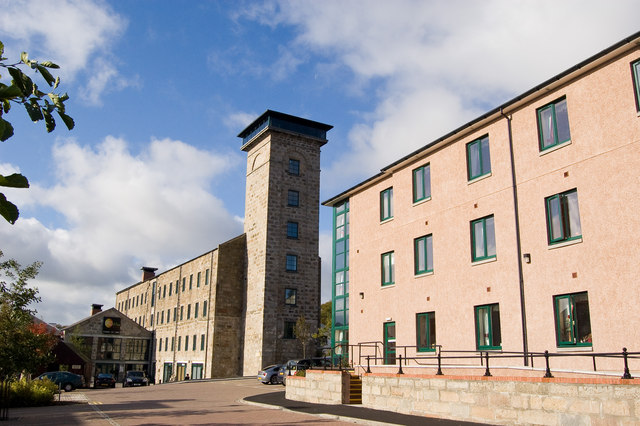
The Stoneywood Paper Mill employs women as rag-pickers; sorters; and for doing finishing jobs though all mill-labour is hard, and the rewards poor.
Being a domestic servant – a main employment at this time for a female in Aberdeen – or a lady’s maid, will also be difficult with her son, Jamie, at her heels. The women work in various-sized households doing very menial cleaning tasks which are repetitive and soul-destroying for some women. Tackling the black-leading of a cast or wrought-iron kitchen range; scrubbing floors on hands and knees; washing down and polishing furniture with semi-toxic preparations – none are easy jobs. A cook is a highly trained domestic servant but not within Margaret’s remit. Being a nursemaid or a nanny, Margaret’s told, is good employment in the Granite City but those jobs are rarely given to widows with a child.
Females find employment as washer-women. Some work from their own home, but across the city of Aberdeen there are large laundries. Working with searing-hot water, bleach and other cleansing materials is a painful way to earn the measly few shillings that the washerwomen are paid. Interior plumbing with running water – hot or cold – is still relatively rare across the city, and most tenement housing has no running water at all. Standpipes outside, or polluted wells, are still the most common ways of drawing water.
Shops are mostly run as a family business, the females of the family ‘assisting’ rather than being in paid employment, so a shop job is unlikely to be found.
Aberdeen at this time is a thriving, constantly-busy fishing port and many fishwives are employed at the harbourside working at different roles. They gather bait; bait the lengthy fishing lines; mend the nets, and gut the herring and other fish. After the catch is processed, the women hoist the heavy creels and baskets onto their backs and trudge from the fish-landing at Pochra Quay, up to the fish markets in the city centre, and in the outskirts. The fishwives do a skilled job earning a pittance and are outside in all kinds of weather. However, the fishing folk of Aberdeen are a very close-knit community with their own cultural identity, customs, and clothing. A fishing job, like shop work, is rarely given to a stranger.
Only a short distance from the centre of Aberdeen, there are still some crofts and small-holdings which employ seasonal agricultural labour, some of the harvesting work given to women. Cash-in-hand for a long day’s toil is a bonus but, being seasonal, it’s not regular enough to live by.
However, when researching employment in Aberdeen, I discovered that a brand new facility opened up to look after the children of female workers. It was initially dedicated to women mainly working in the laundries, or in domestic service. The Aberdeen Association for Improving the Conditions of the Poor (now the VSA – Voluntary Service Aberdeen) opened up its first day nursery in 1871. It catered for children from six weeks to five years, the opening hours being from 5.30 am to 6.30 pm. At that time it cost ‘thruppence a day’, as in three pence sterling (3d) for one child. To register a child for a whole working week would have cost six times that amount, one shilling and sixpence being a considerable amount from a weekly wage. Sending one child there would still have been a struggle for most working women, but sending multiple under-fives would have been incredibly difficult. Though, it was common in the mills to have children four and upwards in a working role, gathering the ‘stoor’ from under the constantly-clacking looms. That’s a shuddering thought but still a sad reality in 1870 when my character, Margaret, arrived in Aberdeen.
On finding the information about the day nursery, I used it in Fraying Skeins, though tweaked the date a little bit to suit my purposes.
What job does Margaret find in Aberdeen, to feed herself and her son, and put a roof over their head? I’ll let you guess, till you find out in Fraying Skeins.
Universal Buy Link: mybook.to/FSSSS
This title / series is available to read on #KindleUnlimited.
Meet Nancy Jardine

Nancy Jardine writes historical adventure fiction, historical saga, time travel historical adventure and contemporary mysteries. Research gobbles up lots of time but it’s a delight, and never a chore. Her garden wouldn’t win any prizes but tending it is a great way to unwind and gives her some lovely plants to post on Instagram!
When not creating her novels, or promoting her writing, she loves to interact with readers at Book and Craft Fairs where she signs/sells paperback versions of her novels. Recently she’s taken part in author panels at Book Festivals.
Memberships include: Historical Novel Society; Society of Authors; Scottish Association of Writers; Federation of Writers Scotland; Romantic Novelists’ Association; and Alliance of Independent Authors. She’s self-published with Ocelot Press.
Connect with Nancy
Website: https://www.nancyjardine.com/
Twitter / X: https://x.com/nansjar
Facebook: https://www.facebook.com/NancyJardinewrites/
Instagram: https://www.instagram.com/nansjar2023/
Threads: https://www.threads.com/@nansjar2023
Bluesky: https://bsky.app/profile/nansjar23.bsky.social
Pinterest: https://uk.pinterest.com/nanjar/
Book Bub: https://www.bookbub.com/profile/nancy-jardine
Amazon Author Page: viewauthor.at/findmybookshere
Goodreads: https://www.goodreads.com/author/show/5139590.Nancy_Jardine


Great post, Nancy!
My thanks for inviting me here today to write a guest post for your readers. It’s grand to visit!