
Born in the glittering courts of Castile and Aragon and forged in the shadow of war, Catalina de Aragón grows up surrounded by queens, rebels, and explorers. She is her mother’s last daughter, the final jewel of a dynasty built on conquest and faith, and the one child Isabella of Castile cannot bear to lose.
But destiny has already claimed Catalina.
Promised to Prince Arthur of England since childhood, she is raised to bind kingdoms, soothe old wounds, and carry the hopes of an empire across the sea. Yet, Spain fractures under rebellion, grief, and the ruthless zeal of its own rulers.
From the burning streets of Granada to the storm‑lashed Bay of Biscay, Catalina and her sisters must navigate a treacherous path shaped by ambition, betrayal, and the dangerous love of men who fear the power of queens. She learns to read cyphers, to read hearts, and to stand unbroken even as her childhood is stripped from her piece by piece.
And when she finally sails for England armed with her mother’s lessons, her father’s steel, and the ghosts of the Alhambra at her back, Catalina steps into her fate not as a girl, but as a force.
A princess.
A survivor.
A daughter of Aragon.
Infidel is the story of a young woman raised for greatness and destined to reshape the fate of nations. This is Catalina, as she has never been seen before. She is fierce, vulnerable, and unforgettable.
A sweeping, intimate portrait of sisterhood, survival, and the making of a dynasty, Infidel reveals the hidden lives of a woman whose courage shaped the Tudor world.
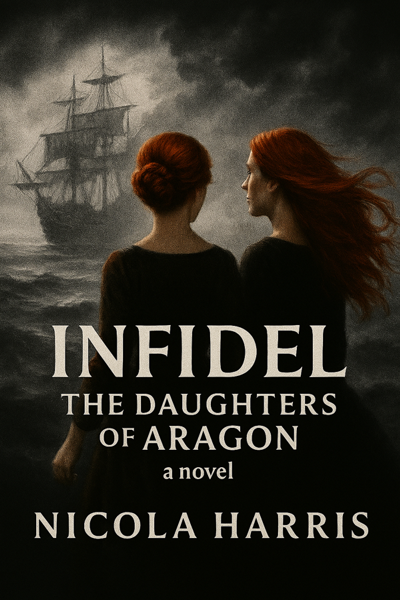
My Review
This book gives us the background of Spanish princesses who most of us have learned about during their adulthood. Catalina, better known as Catherine of Aragon was married to the ill-fated Arthur Tudor, then Henry VIII. Juana, better known as Joanna of Castile, was married to Philip the Handsome and, after his death, confined as insane. She is best known for allegedly carrying a coffin bearing his corpse around Spain. Although we do see the beginning of Juana’s marriage, we see no evidence of her later misfortunes. And Catalina hasn’t yet made it to England. What we do see is their childhoods, written interchangeably in first person, along with two other sisters who are more in the background. Theirs wasn’t a particularly happy childhood:
Catalina:
I crept barefoot through the hall, my nightgown clinging to my legs, my heart thudding like a drum. I didn’t know why I was crying – not truly. Only that I couldn’t stop. The tears had begun after prayers and had not left me, not even when I buried my face in my pillow and tried to be brave.
I pushed open Juana’s door.
She was already in bed, her strawberry‑blonde hair loose across the linen, her eyes open and shining in the dark. She didn’t speak. She simply lifted the blanket and made room.
Catalina was crying because her sister Isabel had just been sent off to Portugal to marry the prince. Suddenly, she realized that all of her sisters, and herself, were destined for the same fate. They may never see their family again. Isabel was twenty years old. Juana was ten, Catalina only five. They grew up under the stern influence of their mother Isabella of Castile and their preoccupied father Ferdinand, whose Catholic sensibilities forced the conversion of thousands of Muslims at the point of the sword. Thousands more were sold into slavery. The wars fought by Ferdinand were a bit hard for me to follow, but I suppose since they are told from the point of view of children, they might naturally be confusing. What was clear were the sensibilities of the princesses, trying to do the right thing, clinging to each other and their precious brother Juan, who died at the age of nineteen. He was only the first of many. Juana, next to be married off, thought she might be lucky with her handsome husband. But her joy turned to grief as he treated her like a possession, giving neither her nor their children the least affection. All he cared about was her closeness to the throne, which grew even more enticing as other heirs died. A woman could inherit the crown of Castile, but her husband could find a way to rule by right of his spouse, and this was where they were heading. That eventuality would come later, not in this book. But we do see the evil signs of what was to come. Catalina was the last daughter to leave home, and she looked forward to her next life with brave apprehension. I, as reader, could only sympathize with her plight.
Universal Buy Link: https://books2read.com/u/4AZDEJ
Read with #KindleUnlimited
Meet Nicola Harris
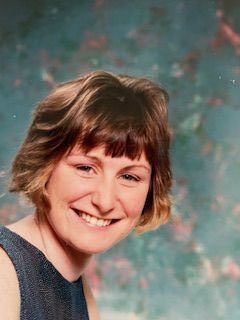
I’ve always been a writer, but it was only when illness forced me to stop everything that I finally had the time to write a novel. After decades of misdiagnosis, I learned I was born with a serious genetic condition, not rare, but profoundly misunderstood. The clues were there from birth, and suddenly, a lifetime of struggle made sense.
Writing became my lifeline: a way to step beyond my pain, to shape my experience into a story, and to find meaning where there had once been only endurance.
I have a lifelong love of children, Counselling, and Psychotherapy Theory and history.
Connect with Nicola
Website: https://nicolaharrisauthor.com/
Instagram: https://instagram.com/@nicola_harris_author
Twitter / X: https://x.com/@harris_nic59544
Facebook: https://www.facebook.com/people/Nicola-Harris-Author/61580352386417/
Bluesky: https://bsky.app/profile/nicolaharrisauthor.bsky.social
Pinterest: pinterest.com/NicolaHarrisAuthor
Amazon Author Page: https://www.amazon.co.uk/stores/Nicola-Harris/author/B0FQ39YKGF
Goodreads: https://www.goodreads.com/author/show/59955210.Nicola_Harris


