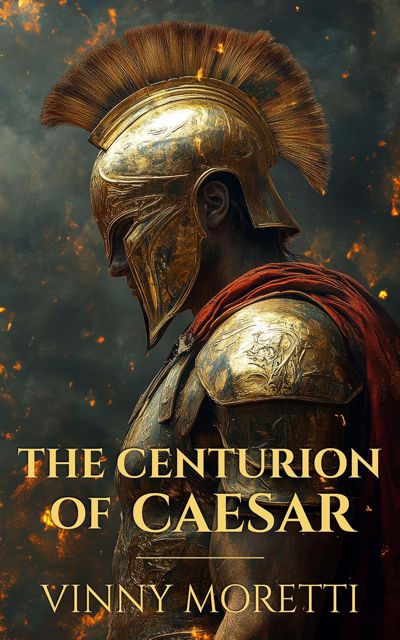
Blurb
A world at war. A Republic in its death throes. A general on the path to immortality.
From the blood-soaked fields of Gaul to the burning streets of Alexandria, from the triumphs of Rome to the treachery of the Senate, The Centurion of Caesar is an unrelenting epic of conquest, loyalty, and the brutal forging of an empire.
Told through the eyes of Flavius, a hardened centurion of Caesar’s Thirteenth Legion, this novel brings to life the violent struggle that reshaped history.
Through battle and bloodshed, he marches at the side of the greatest general the world has ever known—Gaius Julius Caesar. Together, they face the wrath of rebellious Gauls, the legions of Pompey Magnus, and the treachery of those who called themselves Romans. Victory follows them like a shadow, but so does betrayal.
For those who crave epic battles, ruthless strategy, and the clash of empires, this is historical fiction at its most brutal, its most gripping, its most unforgettable.
My Review
In many ways, this is book is a comfortable fit, since I’ve read so many books about Julius Caesar. I can’t say I learned anything new, but we did delve into the heads of the soldiers who followed him, which is a different and satisfying approach. Our protagonist, Flavius, is a self-made man, having risen through the ranks from a terrible beginning. As a native German, the Romans destroyed his family and sent him to the Arena as a slave, where he proved his worth and gained his freedom. By then, he considered himself Roman and joined the legions, where he came to the notice of Julius Caesar and was even promoted to Primus Pilus, top rank of any Centurion:
This role was not merely a title; it was a testament to a soldier’s valor, leadership, and unwavering dedication. The primus pilus commanded the first century of the first cohort, often comprising the legion’s most seasoned and battle-hardened soldiers. In battle formations, the primus pilus stood at the forefront, embodying the legion’s honor and resolve. Beyond the battlefield, he served as a crucial advisor to the legate…As the newly appointed primus pilus, I found myself in a rare and precarious position: advising Julius Caesar directly, standing closer to the heart of power than most centurions ever dreamed.
Good explanation, part of what made this book interesting. The book starts at the siege of Alesia, where the brave but unfortunate Vercingetorix nearly overwhelmed the Romans with his own Gauls as well as a tremendous army or reinforcements. As we know, Caesar was triumphant and returned to Rome in the face of a tempestuous senate determined to cut him down to size. Of course, with the enthusiastic support of his troops Caesar crossed the Rubicon and gave chase to his former ally Pompeius (Pompey the Great), his eternal foe Cato, and the retreating senators. Alas, we don’t get to see much of the battle of Pharsalus against Pompeius because our hero gets knocked out. Then we are off to Egypt, where we meet the mysterious Cleopatra and fight the rampaging Egyptions. This is a lot of territory to cover in 303 pages, so the author necessarily had to skip over minor events to keep the story going. Unfortunately, some of the transitions were just too abrupt and momentum took a while to rebuild. If I didn’t know the history already, I might have been a bit overwhelmed. Nonetheless, I am intrigued enough to pick up the next book.
Amazon: https://www.amazon.com/Centurion-Caesar-Novel-Birth-Empire-ebook/dp/B0F332385J


