
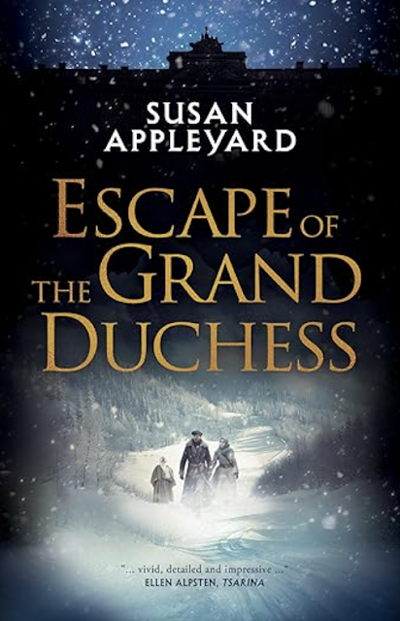
Escape of the Grand Duchess by Susan Appleyard is a gripping historical novel that shatters the notion that royalty is synonymous with privilege and ease. At its heart is Grand Duchess Olga Alexandrovna, the youngest sister of Tsar Nicholas II—a Romanov who defied a doomed destiny and survived.
Unlike her ill-fated brother and his family, Olga’s story is one of resilience, sacrifice, and daring escape. Trapped in a loveless marriage to a reckless gambler—who harbours secrets of his own—she finds hope in the arms of a dashing army lieutenant. But before she can claim her own happiness, she must first endure the brutal realities of World War I, where she serves as a nurse on the frontlines.
As the Russian Empire teeters on the brink of collapse, the infamous Siberian mystic Rasputin tightens his grip on the imperial court, setting the stage for revolution. With the Bolsheviks seizing power and the Romanovs marked for death, Olga faces an impossible choice: risk everything to stay or flee into the unknown with her true love and their children.
Rich in historical detail and driven by an unforgettable heroine, Escape of the Grand Duchess is a sweeping riches-to-rags tale of survival, love, and the strength it takes to forge a new life in the face of unimaginable upheaval.
Guest Post: Rasputin
Grigori Yefimovich Rasputin was born to a peasant family in the Siberian village of Prokovskoye in 1869. In 1887, he married Praskovya Dubrovina, with whom he had three children who survived to adulthood. Rumours suggest he had a misspent youth and early adulthood: drinking, petty thievery and chasing women. At some point, he seems to have experienced some sort of spiritual awakening, abandoned his old life and took to the road as a strannik, a holy wanderer, to visit holy sites.
Arriving eventually in St Petersburg, the capital, he made a strong impression on Archimandrite Theophan who was active in society and presented Rasputin at influential salons. Through Theophan he met two Montenegrin Princesses who dabbled in the occult and were married to uncles of the Tsar. They introduced him to the Imperial Family as a faith healer.
To reach this point in his life Rasputin had met many important and influential people. He must have presented as charming, well-spoken, persuasive, interesting, and worthy of respect to the elite of St Petersburg, and to the parents of the sick child.
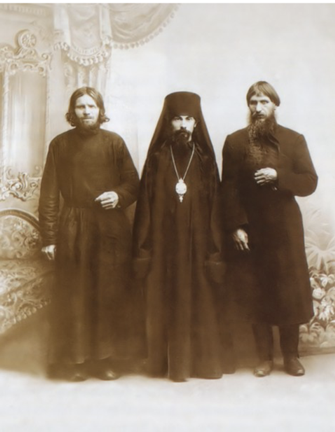
The heir of Russia, the only son, the Tsarevich Alexei was a haemophiliac, and it seems Rasputin was able to heal him. He never did anything to the suffering boy to cause the healing, only prayed. On one occasion, when Rasputin had returned home to the village of Pokrovskoye, Alexei suffered an accident that caused severe bleeding, agony and fever. The doctors could do nothing. They believed he was dying when Empress Alexandra sent a cable asking Rasputin to come immediately, and he sent word back that she was not to worry because Alexei would recover. According to some, the child began to recover immediately, but recover he did, creating the impression that Rasputin could perform miracles from afar.
Haemophilia made its appearance in the children and grandchildren of Queen Victoria. It affected only males, but women were carriers. Alexandra was a granddaughter and a carrier. How she must have suffered knowing she had given her beloved son the dread disease.
From the beginning, Nicholas and Alexandra had made the decision not to release news of their son’s illness to the public and only shared it with close family members. It is understandable that they didn’t want the people to know that the heir had a disease that weakened him and was likely to lead to an early death. On the other hand, knowing that the imperials suffered like them, would have earned sympathy and might have made the people look kindlier upon them.
But did Rasputin really heal Alexei? There are skeptics. Some believe that his prayerful calmness soothed the frantic Alexandra, which in turn eased the suffering of the Tsarevich. Others argue that it was coincidence, that the boy would have recovered anyway, and still others wonder if the whole thing was distorted and exaggerated. An interesting suggestion is that Rasputin forbade the doctors from giving the patient any form of medication including aspirin, which was not then known to be an anticoagulant. I ask myself, if Rasputin was a genuine healer, why did God choose to give a despicable person such powers? And why is there no record of any others Rasputin healed even in St Petersburg? Alexandra suffered from sciatica, having to use a walking stick and a wheelchair in her later years. Why was he never able to heal her?
Once established as a person of importance in the capital, Rasputin acquired an unsavoury reputation. Although he was not an attractive man, having unkempt hair and beard, a barnyard smell, and often wore stained clothes, he attracted women, even some aristocrats. They lined up on the stairs outside his apartment, waiting to see him. He would tell them that there could be no redemption without sin and invited them to ‘sin’ with him. Massive amounts of vodka fuelled orgies with several women, and other men were not exempt.
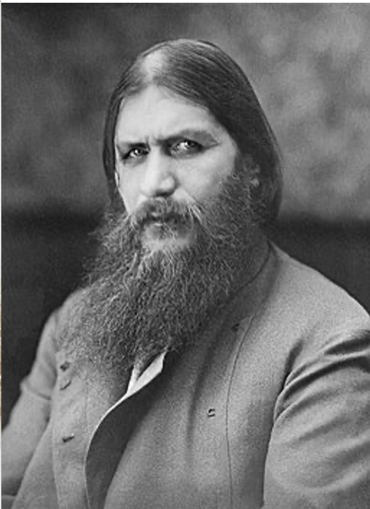
This behaviour by one who claimed to be a holy man was known throughout the city, but Nicholas and Alexandra were devoted to him, believed in him and would hear no word against him. How could they be otherwise when they had witnessed occasions when he had stopped the bleeding and relieved their beloved son’s agony? By this time, Rasputin had become a spiritual adviser to the whole family. St Petersburg society learned that he was not only a regular at the palace but had entrée to the bedrooms of the four imperial daughters. He visited them when they were in their nightdresses to pray with them, and they accepted this behaviour as normal. He was ‘our friend’. Alexandra’s utter devotion to him led to the rumour that he was more than a spiritual adviser, and the appearance of some letters smuggled out of the palace from her to Rasputin only made matters worse as they contained words that one might write to a lover.
‘I wish only for one thing – to fall asleep, fall asleep forever on your shoulders, in your embrace.’
‘Oh, what happiness it is just to feel your presence near me.’
‘Come soon. I am waiting for you and am miserable without you.’
Imagine the titters as these words were passed around at the dinner tables of St Petersburg’s elite. No doubt they were responsible for cartoons painted on walls depicting the Empress and Rasputin in lewd positions. It’s not surprising that they questioned the relationship between the Emperor and Empress of Russia and an unwashed, degenerate peasant from Siberia when they knew nothing about Rasputin healing the Tsarevich.
After war broke out, Nicholas accepted Alexandra’s advice and took command of the Russian forces (from Rasputin’s mouth to her ear), leaving Alexandria to run the government, which was a mistake because when things went badly people blamed the one in command. And the war went badly for Russia in every conceivable way. The men at the front were short of arms, shoes and capable officers. Trains carrying supplies to the front or the wounded back home got stuck in snowbanks or their boilers cracked due to hard frosts. The newspapers reported stories of military supplies being siphoned off by those in charge and sold on the black market.
With Nicholas away at headquarters, Alexandra ran the government always with Rasputin’s advice, hiring and firing ministers and officers on his whim. Through her, he even sent advice to the Tsar on how to conduct the war, although, to his credit, Nicholas wasn’t as always susceptible to Rasputin’s suggestions as his wife.
St Petersburg seethed with discontentment. The regime was hugely unpopular. There were frequent demonstrations, mass protests, strikes in the factories and bread shortages. Rasputin was viewed as a sinister influence on Nicholas and Alexandra and therefore responsible for much of Russia’s problems. A group of noblemen decided they had to get rid of him. Among them was the Tsar’s cousin, Grand Duke Dimitri Pavlovich, and his friend Prince Felix Yusopov, scion of one the country’s wealthiest families. There has been much speculation about the manner of Rasputin’s death; Yusopov himself wrote a lurid account. I think a few things can be trusted as true. He died in the early morning of January 30th 1916 from a single gunshot wound to the head, and his body was found under the ice of the Malaya Nevka River.
His body was buried in a small church in Tsarskoe Selo with the imperial family in attendance, but none of his own family. After Nicholas’s abdication, it was exhumed and burned to prevent it becoming a rallying point for the old regime.
Grand Duke Dimitri was sent to the eastern front to face Turkish guns, which in fact saved his life as he was far from the scene when the Bolsheviks started rounding up and executing members of the Romanov family. Yusopov received a more lenient punishment by being banished to his estates and he too avoided the slaughter by escaping to the continent.
Universal Buy Link: https://books2read.com/u/mlJGEW
Amazon US Paperback: https://www.amazon.com/Escape-Grand-Duchess-Susan-Appleyard/dp/1990688462
Amazon UK Paperback: https://www.amazon.co.uk/Escape-Grand-Duchess-Susan-Appleyard/dp/1990688462
Meet Susan Appleyard

Susan was born in England, which is where she learned to love English history, and now lives in Canada in the summer. In winter she and her husband flee the cold for their second home in Mexico. Susan divides her time between writing and her hobby, oil painting, although writing will always be her first love. She was fortunate in having had two books published traditionally. Since joining the ebook crowd, she has published nine books, some of which have won various awards.
Connect with Susan
Website: https://susanappleyardwriter.wordpress.com
Blog: https://susanappleyardwriter.wordpress.com/blog/
Instagram: https://www.instagram.com/appleyard.susan/
Facebook: https://www.facebook.com/susan.appleyard.9
BookBub: https://www.bookbub.com/authors/susan-appleyard
Amazon Author Page: https://www.amazon.co.uk/stores/Susan-Appleyard/author/B00UTVMT5Y
Goodreads: https://www.goodreads.com/author/show/1283266.Susan_Appleyard


